Cupping massage: what it is, how I work it at my Arabian Ranches studio, and who it’s for
Cupping massage — or masaje con ventosas, as more and more women search for it — is one of the oldest body care techniques. It has been used for centuries in China, Egypt, Greece, traditional Arab culture (حجامة). And, although the image many people have is of an Olympic athlete with round marks on his back, the truth is that well-applied cupping is a very complete, gentle and deeply useful treatment — especially for women with chronic tension, retention, poor circulation or that common Dubai sense of “nothing flows in me”. In this article I tell you what it really is, how I work it at my Arabian Ranches studio, the situations I recommend it for, what you’ll feel during the session, and what to expect afterwards. No big promises, no marketing — just the truth of what I see work.
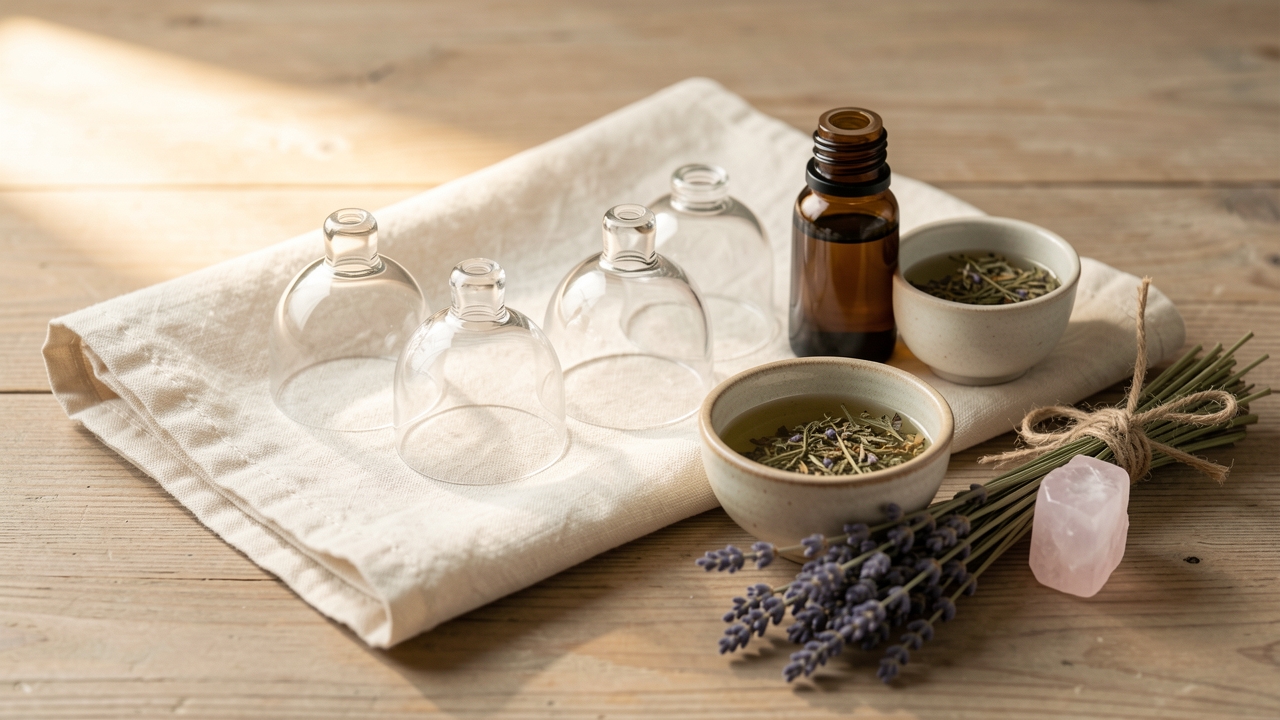
The cups I use in consultation, prepared for a session: glass, different sizes, pure vegetable oil, fresh lavender and a rose quartz. The technique is ancient. The intention, very present.
The essentials of cupping massage
Cupping massage uses the gentle suction of cups on the skin to decongest tissues,
improve circulation, release deep muscular tension and move stagnant energy. At my
studio I apply it therapeutically, never aggressively, combined with manual massage
and adapted oils. It is a complete treatment, not an image trend.
- What it does: decongests, releases tension, activates circulation
- For whom: chronic tension, retention, fatigue, back pain
- How I work it: 60-min session combined with manual massage
- Afterwards: sense of lightness, possible marks lasting several days
- When to avoid: pregnancy (specific areas), acute sensitive skin
What cupping really is
Cupping is a body therapy technique by suction. Cups — traditionally glass or silicone — are applied to the skin creating a controlled vacuum. That vacuum lifts the tissues gently upward, the opposite of conventional massage which presses down. The result is a very deep decongestion of muscular and fascial areas that had been “shrunken” for a long time.
At my studio I use glass cupping cups because they best allow me to control the suction intensity. There are several variants:
- Static cupping: cups are placed at specific points and stay for 5-15 minutes.
- Dynamic (sliding) cupping: cups slide over the oil, covering large muscle areas. My favourite for back and legs.
- Flash cupping: short repeated suctions at points that need punctual stimulus.
In a real session with a client, I almost always combine the three, depending on what the body asks that day. There is no fixed protocol. Each session is a reading.
Where this technique comes from
Worth naming: cupping is not a new trend. It appears in Egyptian medical texts over 3,000 years old. Traditional Chinese medicine integrates it as one of its main techniques. In Arab culture it is known as حجامة (hijama) and has centuries of tradition. In Europe it was widely used in the 19th century in hospitals and medical practices.
What I see in my practice is that more and more women in Dubai — Spanish, British, Lebanese, Indian, Emirati — come asking for it. Sometimes because they’ve seen it on social media, sometimes because they know it from their family tradition, sometimes because their physiotherapist recommended it. My position is the same: it is a valuable technique when applied well, with respect for the body and with criterion.
Situations I recommend it for
In my practice, cupping works especially well in these situations — and a heads-up: for serious clinical cases, the important thing is always to work in parallel with your GP, not instead of her.
Chronic tension in back, neck and shoulders
Probably the number-one reason women ask me for it. Hardened cervicals, trapezius glued to the ears, loaded lower back. If you’ve been carrying the same tension for months and conventional massages only relieve you for a few days, cupping usually offers something different: it decongests deeper layers and tends to leave a more sustained improvement.
Fluid retention and heavy legs
Summer in Dubai, constant AC, office sedentarism and long flights — all of that adds up to that sense of heavy legs, swollen ankles, poor circulation. Dynamic cupping over legs and hips reactivates circulation very clearly.
Diffuse fatigue and a sense of stagnant energy
This is more holistic, more subjective, but clients tell me often. That feeling of “nothing flows in me”, of being stuck. Cupping, especially combined with manual massage, moves stagnant energy in a way many women recognise immediately.
Scars and hardened tissues
After surgery (with your doctor’s authorisation), after childbirth, after old burns. Cups, well applied, help fascial tissue recover mobility. Important: this kind of work I always do after consulting with your medical professional.
Sustained menstrual pain
In the lower abdomen and lumbar area, a gentle cupping session can help ease menstrual pain. It doesn’t cure it, it isn’t a clinical treatment — but it accompanies.
What a session with me looks like
Every therapist has their way. Mine, after 10+ years, follows a clear structure:
1. Prior conversation (10-15 minutes)
Before touching anything, we talk. What brings you today? What’s your history with tension, with your body, with previous treatments? Are you taking any medication? Are you on your period, pregnant, have you had recent surgeries? This conversation allows me to adapt the session to you, not to a protocol.
2. Preparing the body with oil and manual massage
I always start with 5-10 minutes of manual massage with pure vegetable oil (sweet almond or jojoba, depending on your skin). This phase has two functions: preparing skin and tissues for the suction, and giving me a reading of the areas that most need it.
3. Applying the cups
Here is where cupping proper enters. I place the cups following the energetic meridians when I work holistically, or specific muscle groups when I work therapeutically. Suction I regulate to your tolerance — we start gentle, we go higher if your body asks for it.
Some cups stay static. Others I slide slowly over the oil, covering large areas.
4. Final manual work
After the cups, I finish with another 10-15 minutes of manual massage over the worked areas. This helps the body integrate what has moved and relaxes the layers that remain tense.
5. Closing and recommendations
I get you up slowly, offer water, we talk about what you felt and I give you recommendations for the next 2-3 days: hydration, rest, no intense sun exposure on the worked areas.
The full session lasts about 60 minutes. If you want to go deeper into how I approach manual work generally, my article on holistic massage: what it is gives you the detail.
The marks: what they are and what they aren’t
This needs to be named clearly. After a cupping session there are usually marks: reddish, sometimes purplish circles where the cups were. The first few times you see them they can be scary — but they are not conventional bruises. They are the visible manifestation of the decongestion process.
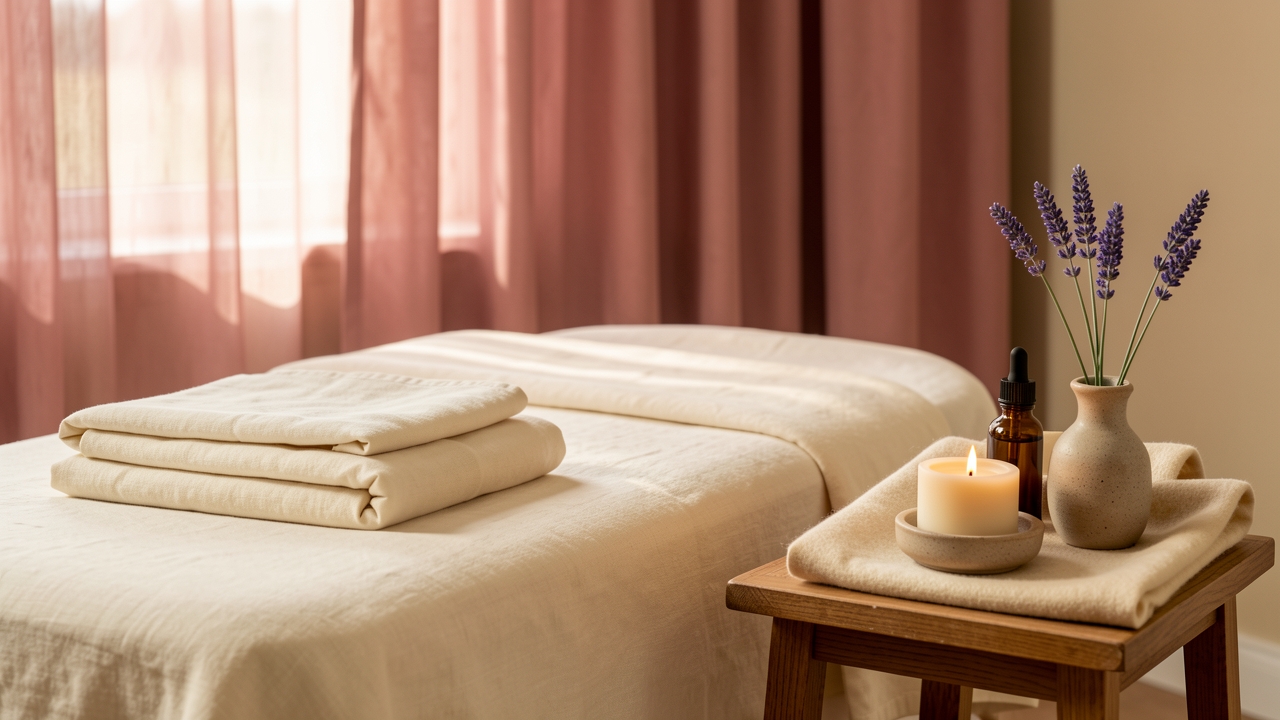
The treatment table prepared for a session at my studio. Clean sheets, pure oil at hand, a candle, a blanket for after. Everything ready so you don’t have to think about anything.
Some important things:
- They don’t hurt (or if they do, it’s a mild discomfort).
- They last between 3 and 10 days, depending on the person and session intensity.
- The darker they are, the more stagnation there was in that area — paradoxically, a strong mark is good news.
- They go away on their own, with no need for anything special.
If you have an important event with a short dress or low neckline in the following days, tell me before and I’ll adjust the zones or the cupping type.
What you’ll feel during and after
What clients typically tell me:
During: a feeling of comfortable suction, a kind of soft “lift” upward. Some say it’s relaxing, others that it’s activating. When the cups slide, the oil makes the gliding very fluid.
Immediately after: lighter legs, loose shoulders, a general sense of circulation. Sometimes a slight comfortable tiredness (like after a long walk).
24-48 hours after: some women notice a mild energy dip while the body processes the decongestion. It’s normal. Drink more water, rest, don’t train intensely. It passes quickly.
3-7 days after: the sustained improvement. Deep muscular tension is usually clearly lower. If it was a chronic area, the improvement can last weeks.
Who it is NOT indicated for
I’m clear on this. Cupping is not for every situation and there are times I prefer not to apply it:
- Pregnancy: I avoid the abdomen and low lumbar area. In other zones (neck, shoulders) gentle technique is fine.
- Very sensitive skin or active eczema in the area.
- Thrombosis or serious circulatory problems (always consult your doctor).
- Strong anticoagulant treatment.
- Open wounds or recent post-surgery (wait for your surgeon’s clearance).
- Active cancer in treatment: only with medical authorisation.
- Children: I only work with adult women, so this doesn’t apply at my practice.
If you have doubts about whether it suits you, the free 15-minute initial consultation is designed exactly for that. We talk it through without commitment.
Combinations that work especially well
Cupping yields more when intelligently combined with other tools:
Cupping + manual lymphatic drainage
For women with sustained retention, alternating cupping and lymphatic drainage sessions in a cycle of several weeks multiplies the results. Cupping decongests the deep, drainage mobilises the surface fluid.
Cupping + personalised aromatherapy
The oil I use during the session can carry a formula adapted to you: lavender + marjoram for tension, geranium + cypress for circulation, rosemary + ginger for fatigue. My article on aromatherapy for the female hormonal system details how I work with adapted formulas.
Cupping + Reiki after
For clients with very energetic tension (more than muscular), I sometimes finish with 15 minutes of Reiki after the cupping. Cupping moves the body, Reiki integrates the energy.
Cupping + Bach Flowers in parallel
If there’s an emotional load behind sustained tension — and there often is — a Bach formula works in parallel for three weeks while we do the physical sessions.
About my treatments at Arabian Ranches
If you’d like to go deeper into any of the topics covered in this article, at my Arabian Ranches studio I offer several treatments: Reiki with chakra balancing, therapeutic and aromatherapy massages, cupping massage, manual lymphatic drainage, Bach Flower therapy and personalised essential oil formulas, among others.
📋 See the full list and up-to-date pricing at Treatments.
✨ First visit: includes a free 15-minute initial consultation to understand your case and tailor the treatment. New clients also receive a 10% discount on their first treatment.
Book your session here or contact me if you have any prior questions.
Frequently asked questions
How many sessions do I need?
It depends on what you carry and your goal. For punctual tension, a single session already makes a difference. For chronic processes (sustained tension, persistent retention), I recommend a cycle of 3-5 sessions spaced every 10-15 days. We look at it together in consultation.
Can the marks be avoided?
To some extent, yes. With gentler sessions or flash cupping the marks are minimal. But there is also less deep decongestion. If what matters to you is not having marks (upcoming wedding, photo shoot), tell me and we adapt the cupping type.
Does it hurt?
No. The sensation is of gentle suction upward, not pressure. Some women even fall asleep during the session. If at any moment it bothers you, we lift that cup and lower the intensity.
When is it not a good idea?
I detail it above in the “Who it is NOT indicated for” section: pregnancy in certain zones, very reactive skin, thrombosis, anticoagulant treatment, recent surgeries, active cancer. In any doubt, I’ll recommend you talk to your doctor first.
What do I do after the session?
The first 24-48 hours: drink more water, avoid intense exercise, no direct sun on the worked areas, warm shower (not hot), eat light. Your body is processing the decongestion and welcomes rest.
Can I combine cupping with other treatments?
Yes. In fact I routinely combine it with lymphatic drainage, personalised aromatherapy, Reiki and Bach Flowers. In consultation we design the combination that makes sense for you.
Is it the same as traditional hijama?
Traditional Arab hijama (حجامة) also uses suction cups, but in some cases includes small controlled incisions to extract blood — that is wet hijama, a medical practice requiring specific training and NOT what I offer. At my studio I apply exclusively dry cupping, no blood, no incisions, in a holistic therapeutic format.