What is Reiki? A practitioner’s complete guide from Dubai
Reiki is a Japanese energy therapy that uses the gentle laying-on of hands to channel vital energy — called ki — into the body, balancing the physical, emotional and energetic systems. In a typical 45–60 minute session, the client remains fully clothed and relaxed while the practitioner works over specific energy points. In this guide I explain — from my daily experience in my studio in Arabian Ranches — what Reiki actually is, how a session works, and which specific problems it can be a real tool for.
The essentials of Reiki
Reiki is a Japanese energy therapy developed by Mikao Usui in 1922. A certified practitioner
places her hands on or just above the body to channel vital energy, helping regulate the
nervous system, release emotional tension and promote deep relaxation.
- Origin: Japan, 1922 — founder Mikao Usui
- Session length: 45 to 60 minutes
- What it helps: chronic stress, anxiety, insomnia, physical tension, emotional blocks
- What it’s like: fully clothed on a treatment table, no invasive pressure or massage
- Cost in Dubai: from AED 300 at Rosana Holistic Studio (Arabian Ranches)
- Typical results: noticeable from the first session, with cumulative effects over 3–5 session cycles
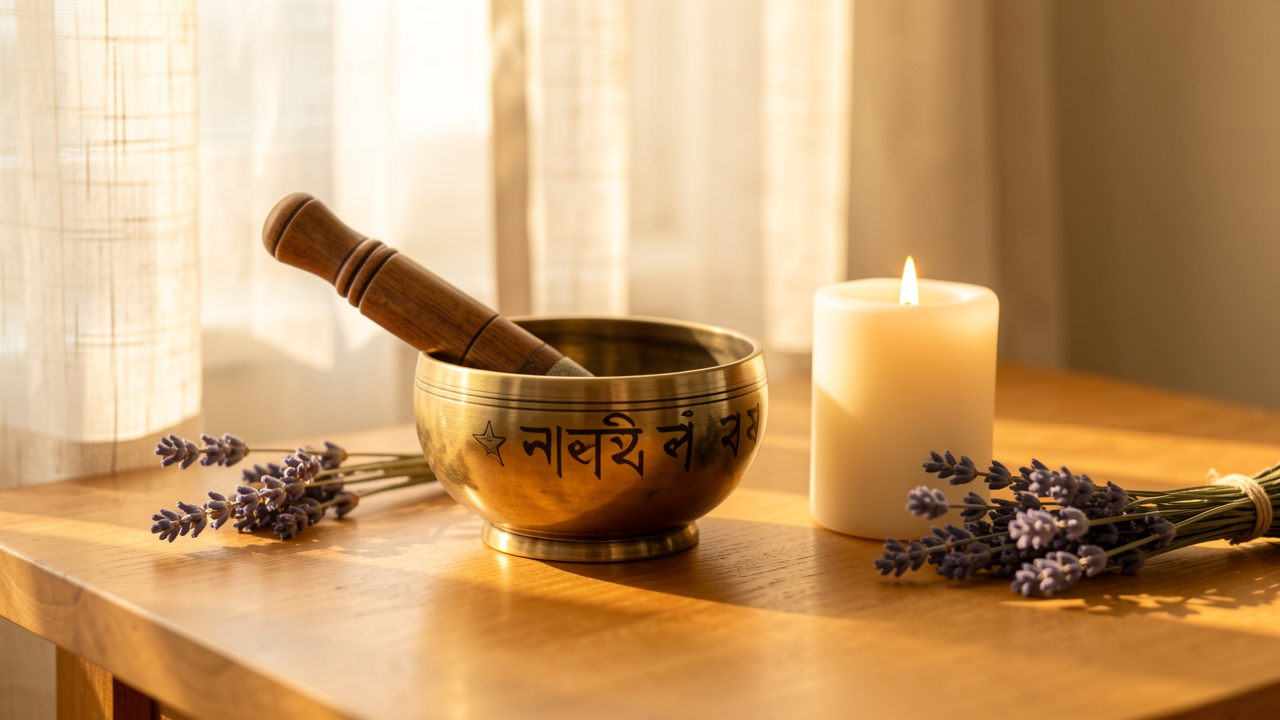
The Tibetan singing bowl, one of the tools I use to close every Reiki session in my studio.
Where does Reiki come from? A Japanese tradition over 100 years old
Reiki was developed by Mikao Usui, a Japanese teacher and spiritual practitioner, in 1922 — more than a century ago. The word Reiki comes from two Japanese terms: rei (universal, spiritual) and ki (vital energy, the same word that translates as qi in Chinese). Literally it means “universal vital energy”.
According to tradition, Usui discovered the method after a 21-day meditation and fast on Mount Kurama, a sacred mountain near Kyoto, in March 1922. From there he founded the Usui Reiki Ryōhō Gakkai — the official Reiki society, which is still active in Tokyo today. The technique reached the West in the 1930s through Hawayo Takata, who trained the first North American teachers.
Today Reiki is offered in public-sector hospitals across the United Kingdom as a complementary therapy (it doesn’t replace medicine, it accompanies it), especially in cancer-care units. NHS hospitals such as the Royal Cornwall, University College London Hospitals, The Christie in Manchester, and Guy’s and St Thomas’ include it in their complementary therapy programmes for oncology patients. This isn’t a modern fad — it’s a practice with growing institutional backing.
In Dubai specifically, Reiki has gained real popularity over the last 10 years, especially among the expatriate community looking for therapeutic complements to the intense pace of life the city offers. It’s one of the most requested modalities at my studio in Arabian Ranches.
Why the origin matters
Knowing where a technique comes from helps you understand the depth and spiritual lineage that sustains this centuries-old practice. It’s a coded path, with tradition, structured training, and protocols. Any serious Reiki practitioner has verifiable training levels (Reiki I, II, Master) issued by a recognised association. Feeling safe with who is accompanying you is part of the healing journey.
How does a Reiki session actually work?
This is the question I get most in consultation — and the honest answer is that the exact mechanism isn’t fully understood by current science. What is documented is what the therapy produces: deep relaxation of the nervous system, measurable drops in cortisol (the stress hormone), heart-rate regulation, and improved sleep patterns in controlled studies.
The concept of ki or vital energy
Asian traditional medicines — Chinese, Japanese, Indian Ayurveda — all share a central idea: the human body isn’t only physical matter, it’s also an energetic system. That vital energy (ki in Japanese, qi in Chinese, prana in Sanskrit) flows through specific channels of the body. When the flow is free, there is health. When it’s blocked — by chronic stress, repressed emotions, unprocessed trauma, accumulated muscular tension — physical and emotional symptoms appear.
Reiki works on this subtle energetic layer, while also dialoguing with the autonomic nervous system — the one that controls involuntary responses like heart rate, digestion and breathing. When the parasympathetic system (the “rest mode”) activates deeply during a session, the body enters a state of self-repair and energy begins to flow freely again.
The role of the practitioner as a channel
In Reiki, the practitioner doesn’t “give” her own energy. She acts as a channel: she places her hands on or just above the client’s body, in specific positions corresponding to the energy centres known as chakras. Universal energy flows through the practitioner to wherever the client’s body needs it most.
In my case, before each session I do a preliminary measurement with a pendulum over each of the seven main chakras. This tells me which centres are active, which are blocked, and where I need to spend more time. Every session is completely different because the body never arrives the same way twice.
What does a session actually feel like?
This is the other inevitable question. And here I answer from my 10+ years of practice, the last five accompanying clients in my Dubai studio:
Every client feels something different, and all of it is valid. The most common experiences my clients in Dubai report include:
- Intense heat in specific areas of the body (especially where there’s accumulated tension — shoulders, abdomen, forehead)
- Soft tingling in hands, feet or crown
- A feeling of heaviness or “sinking” into the table — the body letting go of control
- Vivid mental imagery, sometimes with colours, landscapes or old memories
- Emotions surfacing — some clients cry without knowing why, others laugh
- Deep sleep — around 40% of my clients fall asleep during the session
- A calm afterwards that lasts several days, often described as “having the system reset”
What matters: you don’t have to feel anything spectacular for the session to be working. Some clients don’t perceive clear physical sensations during the session itself, but when they get up they notice obvious differences: better sleep that night, less emotional reactivity, a headache that disappears. The body processes below the level of conscious awareness.
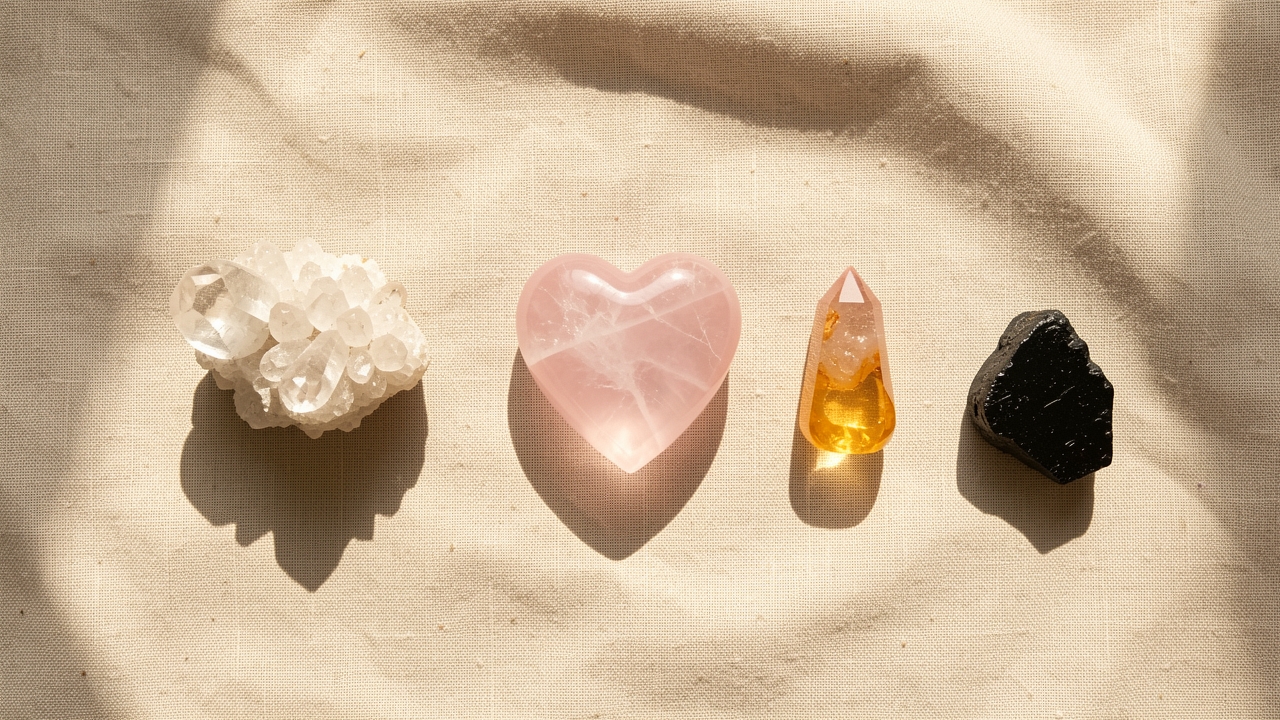
My crystal collection: rose quartz, amethyst, citrine and obsidian. Each session uses different crystals depending on what the body asks for.
Which life processes does Reiki accompany?
Reiki is a deep and energetically powerful tool, especially valuable for certain life processes. After a decade in practice, these are the paths where I most often see healing unfold:
Where Reiki accompanies with strength
- Chronic stress and burnout: most of my clients in Dubai come to me for this. The pace of life in the Emirates is intense. Reiki acts deeply on the nervous system, helping lower cortisol and rebalance vital energy.
- Anxiety and panic attacks: especially combined with psychological support. Reiki helps regulate the “fight or flight” response from a soft, energetic place.
- Insomnia and sleep problems: many clients report sleeping deeply for the first time in months after a session.
- Chronic tension-based pain: especially tension headaches, neck and shoulder pain, jaw clenching (bruxism).
- Emotional blocks and grief: Reiki creates a safe space for repressed emotions to surface, be processed and integrated.
- Post-surgical recovery: as a complement to manual lymphatic drainage, Reiki speeds recovery by activating the parasympathetic system.
- Support during cancer processes: as a complement to medical treatments, it helps manage side effects and reduce pre-chemotherapy anxiety.
- Stress-related digestive disorders: irritable bowel, gastritis, reflux associated with tension.
When Reiki accompanies best alongside other therapies
- Severe structural problems (disc herniation, fractures, acute muscle injuries): Reiki adds energetic support while physical medicine addresses the structural side.
- Ongoing psychiatric processes: Reiki accompanies gently, always in collaboration with the medical team.
- Active infections or acute medical processes: medical attention first, then Reiki helps integrate and support recovery.
In my way of working, Reiki accompanies with respect every medical process. I never present it as a substitute: when a client arrives with a condition that needs clinical care, the first step is to refer her — and from there we add Reiki as energetic support to the journey.
My process at Rosana Holistic Studio
At my studio in Arabian Ranches, every Reiki session follows a structured flow but is always adapted to the client of the day and to what I’m perceiving energetically. This is the sequence that holds my work:
- Initial conversation (10–15 min, no charge): I ask how you arrive today, what you want to work on, if there’s something specific weighing on you. I don’t rush you.
- Preparing the space: I light candles, set up specific aromatherapy according to what your energy is asking for (lavender for anxiety, sandalwood for grounding, rose for emotional work), and play 432 Hz music.
- Opening with the Tibetan singing bowl: I sound the bowl at the beginning of every session to open the energetic space and prepare the field we’ll be working in.
- Pendulum reading and aura cleansing: I check each of the seven main chakras to identify where you need more work, and then I perform an energetic cleansing of the aura, harmonising and sealing the auric field wherever I perceive blocks.
- The Reiki session (45–60 min): hands-on positions following the Usui method as a foundation, but allowing myself to be guided intuitively — sometimes I stay longer over certain chakras depending on what I’m sensing energetically. Each body shows me its own rhythm.
- Closing with the Tibetan singing bowl: I sound the bowl again at the end of the session to close the energetic space and integrate the work done, accompanying the body in its gentle return.
- Crystal support and integration (10 min): I add specific crystals (amethyst for mental calm, rose quartz for the heart, citrine for vital energy), I leave you water, we talk about what you felt, and I give you a couple of suggestions for the next few days.
Book your first session here — new clients receive 10% off their first session.
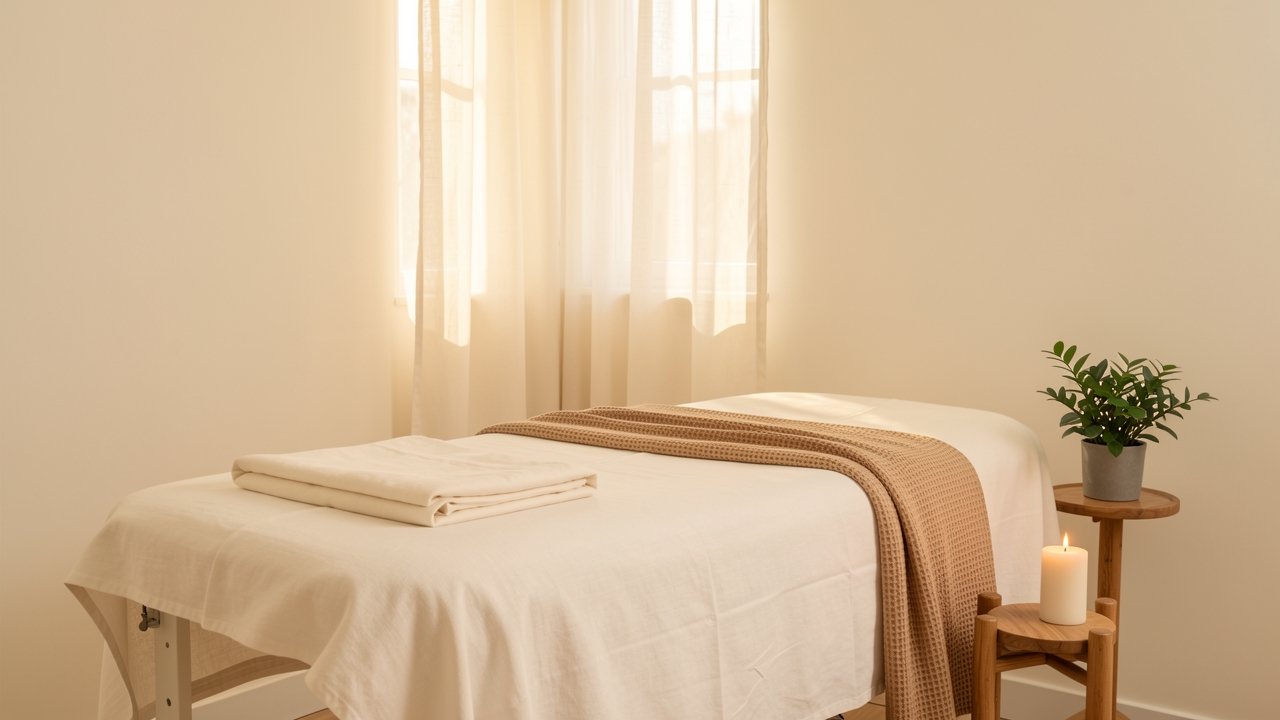
A corner of my studio in Arabian Ranches prepared for a Reiki session. Every element — the light, the music, the aromas — is designed so your nervous system drops into rest mode the moment you walk in.
How many Reiki sessions do you actually need?
I’ll answer with the same honesty I give my clients:
A single session will give you a beautiful first encounter with the energy, an invitation to this path — but deep changes arrive with continuity.
My recommendation based on what I see weekly:
- For general maintenance (everyday stress management): 1 session every 3–4 weeks, indefinitely.
- To resolve a specific condition (anxiety, insomnia, emotional block): a cycle of 5 sessions spaced 7–10 days apart. After that cycle, most of my clients choose to switch to monthly maintenance.
- To accompany a medical process (post-surgery, oncology, intense grief): a more frequent pattern — 2 sessions per week for 3–4 weeks, then we reduce the rhythm.
If after 3 sessions a client feels the process isn’t resonating, we speak honestly: sometimes Reiki is exactly what the soul is asking for in that moment, other times it’s wise to complement it with other therapies. Each journey is unique, and I always prefer to accompany you with transparency rather than insisting when something isn’t flowing.
What does science say about Reiki?
An important topic, especially for my more analytical clients. Here without sugar-coating:
The scientific evidence on Reiki is preliminary. There are studies — small, scattered, with very varied methodologies — that point to positive effects on stress, anxiety and pain perception. But there are not yet large, rigorous clinical trials that would let conventional medicine speak of robust evidence. What is well documented is the effect of deep relaxation on the autonomic nervous system: when the body enters a parasympathetic state, cortisol levels drop, heart rate is regulated and cellular repair processes improve.
This matters because, whatever the ultimate mechanism of Reiki (the ki energy, conscious touch, the deep state of calm, or a combination), the physiological outcome is real and measurable: the body enters rest-and-repair mode.
Serious hospitals in the United Kingdom offer Reiki as a complementary therapy — not a substitute. Hospitals such as the Royal Cornwall, University College London Hospitals, The Christie in Manchester and Guy’s and St Thomas’ in London are publicly verifiable examples.
My personal position, after a decade in practice: I don’t need science to explain every nuance of the mechanism in order to trust a tool that I see transforming lives every day. And at the same time, I deeply respect that for many clients knowing where the evidence stands matters. That’s why I tell you honestly.
What I’m clear about after a decade in practice: the effects are real, deep, and felt in the body, the mind and the spirit. Beyond the mechanism debate, my clients return because they feel the transformation.
How to book your first Reiki session in Dubai
If after reading this you think Reiki could help you, this is how we start:
- Online: directly at rosanaholisticstudio.com/en/book — choose date and time in under 2 minutes.
- WhatsApp: message me at +971 55 686 2939 and we’ll resolve any question before booking.
- Email: rosanaholisticstudio@gmail.com.
For your first visit I recommend booking at least 24 hours ahead, so I have time to prepare the space with the right intention based on what you tell me.
New clients receive 10% off their first session booked online. The base price is AED 300 for a 60-minute session, and if you later decide to commit to a 5-session process there are package discounts.
I work in English and Spanish from my studio in Arabian Ranches, 10–20 minutes from Dubai Hills, Emirates Hills, The Springs, The Meadows, Mudon, Damac Hills and Town Square.
Frequently asked questions about Reiki
Does Reiki have contraindications?
No. Reiki is a completely non-invasive therapy — no pressure, no physical manipulation, no substances. It’s safe during pregnancy, post-surgery (with medical clearance), during oncological treatments, and compatible with any medication. The only “precaution” is that if you have an active medical process, we work with it as a complement, not a substitute.
Do I need to believe in Reiki for it to work?
No. The activation of the parasympathetic nervous system and the regulation of cortisol happen independently of your beliefs. I’ve had sceptical clients who stayed because they simply walked out feeling better. That said: it helps to come with an open mind and your guard down.
Is Reiki the same as energy massage?
No. Energy massage combines elements of physical massage with energy work. Traditional Reiki doesn’t include physical manipulation — the practitioner only places her hands. If you’re looking for the combination, I also offer the Personalised Ritual, which blends Reiki, holistic massage and aromatherapy.
How much does a Reiki session cost in Dubai?
In the Dubai market prices range between AED 250 and 800 per session. At Rosana Holistic Studio the base price is AED 300 for a 60-minute session, with a 10% discount on the first session and better pricing on 5-session packages.
Is there a difference between Western and Japanese Reiki?
Yes — subtle but real. Western Reiki (Usui-Takata, the most widespread style in Europe and the Americas) follows standardised hand positions in a fairly fixed sequence. Traditional Japanese schools (Jikiden Reiki, Komyo Reiki) tend to work more intuitively, letting the practitioner feel where to place the hands according to the energy of the moment. In my consultation I use the Usui-method positions as a foundation, but I always adapt them to what each body shows me on the day — that’s what makes every session different.