The 7 chakras: a complete guide from a holistic therapist in Dubai
The chakras are the seven main energy centres of the human body, aligned along the spine from the base to the crown of the head. Each one governs a physical area, an emotional plane and a specific spiritual dimension. When a chakra is open and flowing, that area of your life feels harmonious. When it gets blocked — through stress, trauma, repressed emotion — physical, emotional or energetic symptoms appear. In this guide, drawn from my daily practice as a holistic therapist in Dubai, I explain each chakra, how to recognise when it’s out of balance, and how I work with them in my studio in Arabian Ranches.
The essentials of the 7 chakras
The chakras are seven energy vortices running along the spine from the base to the crown.
Each one regulates physical organs, emotions and an aspect of spiritual life. When they flow,
there is harmony; when they block, symptoms appear in the body, the mind or our relationships.
- How many: 7 main chakras (there are also secondary ones)
- Origin: Indian tantric and yogic traditions, over 2,500 years old
- Why work with them: release emotional blocks, recover vitality, align body and spirit
- How they are balanced: Reiki, meditation, sound (Tibetan bowl), conscious breathing, crystals
- Session in Dubai: from AED 300 at Rosana Holistic Studio (Arabian Ranches)
- Results: greater mental clarity, emotional calm, the feeling of “coming home” to your own body
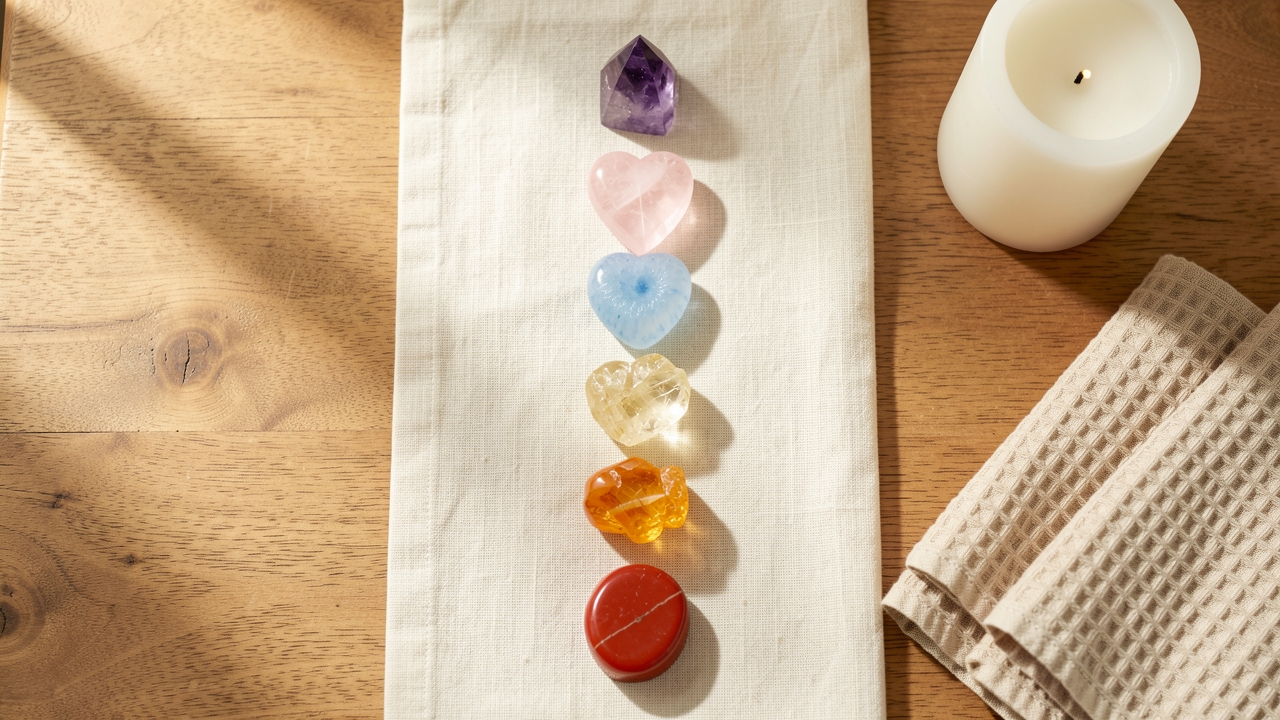
My treatment table prepared before an energy session: each crystal corresponds to one of the seven main chakras.
What are the chakras? A gentle introduction
The word chakra comes from Sanskrit and literally means “wheel” or “spinning disc”. In the Indian tantric and yogic traditions — where the system was first described over 2,500 years ago — chakras are understood as vortices of energy that receive, process and distribute vital energy (called prana in Sanskrit, ki in Japanese, qi in Chinese) throughout the body.
Although they are not visible to the naked eye, the chakras align with real nerve plexuses and endocrine glands of the physical body. That is why when we work with a chakra energetically, we are also influencing concrete organs and systems.
Each of the seven main chakras has:
- A specific physical location on the body
- A colour that represents it in tradition
- An associated element (earth, water, fire, air, ether…)
- An emotion or life dimension it governs
- Characteristic symptoms when out of balance
- Concrete practices to bring it back into balance
In my way of working, reading the chakras before each session lets me listen to exactly where the body is asking for support that day. That is why I use a pendulum at the start: it isn’t a medical diagnosis, it’s an energetic conversation that guides how I will place my hands during the Reiki.
The 7 main chakras, one by one
1. Muladhara · Root chakra
- Location: base of the spine, perineum
- Colour: red
- Element: earth
- Governs: survival, basic safety, grounding, relationship with the physical body, money, home
The root chakra is the base of the whole energy system. When it is healthy, you feel that you belong to life: safe in your body, feet on the ground, with enough trust that your basic needs are met.
When it is out of balance, you might feel:
- Constant low-level anxiety, a vague fear of the future
- Difficulty trusting in abundance (the sense of “not enough”)
- Tension in the legs, lower back, lower digestive issues
- The sense of “living in your head” rather than in your body
This is one of the chakras I most often see blocked in my Dubai consultation, especially in expatriate women: changing country and rebuilding roots takes time, and the body registers it long before the mind does.
2. Svadhisthana · Sacral chakra
- Location: two fingers below the navel, pelvic area
- Colour: orange
- Element: water
- Governs: pleasure, creativity, sexuality, emotions, fluidity, capacity for enjoyment
The sacral chakra is the centre of the inner water: emotions, desire, creativity, sensuality. When it flows, you feel alive, creative, able to enjoy everyday life without guilt.
Typical imbalances:
- Emotional blocks or emotions that overflow uncontrollably
- Loss of desire, creative dryness, lack of spark
- Tension in the pelvic area, irregular menstrual cycles
- The feeling of having to “control” everything all the time
Working on this chakra is especially healing after periods of intense stress, grief, or strong life transitions.
3. Manipura · Solar plexus chakra
- Location: stomach area
- Colour: yellow
- Element: fire
- Governs: personal power, self-esteem, will, identity, capacity to set boundaries
The solar plexus is the inner fire: your sense of self, your strength, your “I am”. When it is healthy, you know who you are, you say what you think, you set limits without guilt.
When it blocks:
- Difficulty saying “no”, setting boundaries
- Fragile self-esteem, doubting every decision
- Upper digestive issues: gastritis, reflux, the feeling of a “knot in the stomach”
- Chronic tiredness, lack of drive
Many clients arriving with anxiety or burnout carry an important block here. Energy work in this area often releases emotions held for years.
4. Anahata · Heart chakra
- Location: centre of the chest
- Colour: green (and rose)
- Element: air
- Governs: love, compassion, forgiveness, connection to self and to others
The heart chakra is the bridge between the three lower chakras (body, emotion, will) and the three upper ones (expression, intuition, spirit). When it is open, there is the capacity to love without losing yourself, to receive, to forgive.
Common imbalances:
- A sense of isolation, difficulty opening up
- Unprocessed grief that still weighs
- Chest pain or a sense of “pressure” without medical cause
- Repeating patterns in relationships
In my experience, this chakra responds deeply to the Tibetan singing bowl and to rose quartz. It is one of the energetic transformations that lasts longest.
5. Vishuddha · Throat chakra
- Location: centre of the throat
- Colour: sky blue
- Element: ether / sound
- Governs: communication, authentic expression, personal truth, listening
The throat chakra governs how you express yourself: what you say, what you keep silent, what you believe you deserve to say.
When blocked:
- Difficulty expressing what you feel or think
- A voice that breaks in emotional moments
- Recurring throat, thyroid or jaw issues (bruxism)
- The sense of “a lump in the throat”
Many women carry generations of accumulated silence here. Releasing it isn’t just about talking more — it’s about recovering the right to speak your truth without asking permission.
6. Ajna · Third eye chakra
- Location: between the eyebrows, slightly above
- Colour: indigo / dark violet
- Element: light
- Governs: intuition, inner perception, mental clarity, vision
The third eye is the seat of intuition, the capacity to see beyond the obvious. When it is healthy, you trust your inner wisdom and take decisions from a clear place.
Imbalances:
- Intuitive block, the sense of “not knowing what I want”
- Obsessive thinking, a mind that won’t stop
- Tension headaches, vision problems
- Difficulty dreaming or remembering dreams
This chakra responds beautifully to silent meditation, work with amethyst, and conscious pauses during the day.
7. Sahasrara · Crown chakra
- Location: top of the head, crown
- Colour: violet or luminous white
- Element: pure consciousness
- Governs: spiritual connection, sense of purpose, union with something larger
The crown chakra is the doorway between your individuality and the transcendent: the sense of belonging to something greater than yourself, whether you call it God, the Universe, life, or nature.
When out of balance:
- A sense of existential emptiness, “what is all this for?”
- Spiritual disconnection, feeling disoriented in life
- Headaches at the crown, high sensitivity to light
- Isolation beyond the emotional
Working with this chakra is especially important during grief, life transitions, or when a client is searching for meaning.
How do chakras get out of balance?
Chakras don’t “break” — they block, close or become over-active. The most common causes I see in consultation:
- Chronic stress: closes the root and solar plexus
- Emotions held back for years: blocks the sacral, heart and throat
- Unprocessed grief: closes the heart chakra
- Untreated trauma: can close several chakras at once
- Living disconnected from the body (living “in your head”): closes root and sacral
- Living disconnected from something larger: closes the crown
What matters: a block is not a personal failure. It is valuable information. The body is telling you where it needs attention. That is why in my consultation the first step isn’t to “fix” — it is to listen to what each chakra has to tell us.
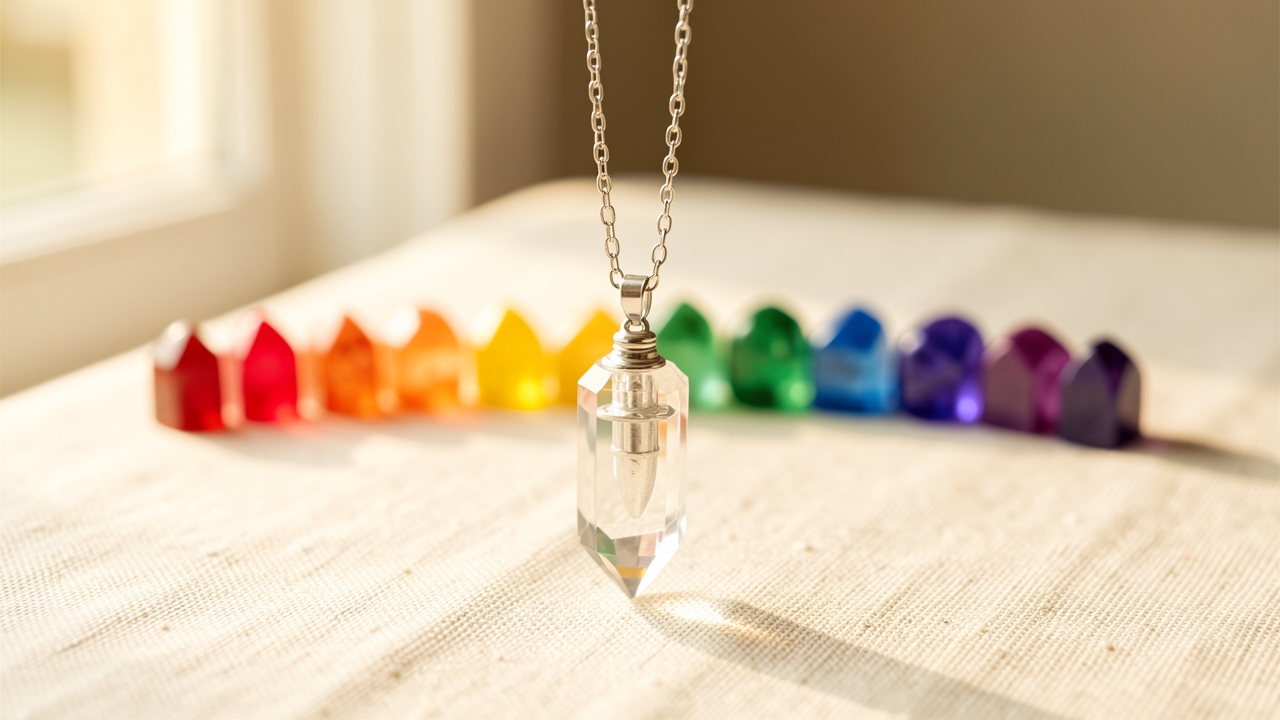
The pendulum I use for the initial energy reading: with it I move across each of the seven main chakras before beginning a session.
How I work with the chakras in my studio
In my studio in Arabian Ranches, the chakras are a compass that guides the whole session. This is how I integrate them:
- Initial pendulum reading: at the start of each session I move across the seven main chakras. The pendulum shows me which are active, which are weak, and where there are blocks.
- Opening with the Tibetan singing bowl: I sound the bowl to prepare the energetic field before the hands-on work begins.
- Reiki adapted to the reading: during the Reiki session I place my hands following the Usui method as a foundation, but I stay longer on the chakras the reading showed weak or blocked. Each body shows me its own rhythm.
- Aura cleansing: when I perceive significant energy blocks, I cleanse the auric field and seal the areas where there was disturbance.
- Closing with the Tibetan singing bowl: I sound the bowl again at the end to integrate the work and close the energetic space gently.
- Crystal support: I finish with crystals matched to the chakras worked — rose quartz for the heart, amethyst for the third eye, citrine for the solar plexus, and so on.
Book your first session here — new clients receive 10% off their first session.
Can chakras be “cleansed” or “opened” just once?
I get this question often — and the honest answer is not exactly.
Chakras are dynamic: they open and close depending on what you live each day. A deep session can release an important block, but life keeps bringing experiences that tense, contract or overload certain centres again.
That is why chakra work isn’t a one-off “fix” — it is a practice of continuous care, just like caring for sleep or nutrition. The good news is that with time you learn to recognise when a chakra is starting to close long before a physical symptom appears — and that changes everything.
In my experience, cycles of 5 sessions spaced 7-10 days apart are enough to release an important block. After that, one session every 3-4 weeks keeps the system in flow.
Frequently asked questions about the chakras
Does having a blocked chakra mean I’m ill?
No. It means there is an area of your life that needs attention. Energy blocks are early signals, long before they become physical illness. Attending to them in time is a form of preventive self-care.
How many sessions do I need to balance a chakra?
It depends on how long the block has been there and what caused it. For a recent block, 1-3 sessions are usually enough. For older patterns (years of stress, unprocessed grief, trauma), a cycle of 5 sessions usually produces a clear shift.
Can I work my chakras at home?
Yes, partially. Meditation, conscious breathing, yoga, journalling, walking barefoot on the earth — all are practices that support the energetic system. What a therapy session offers is external reading: someone listening to what your body is asking when you can’t hear it yourself.
Do chakras have a scientific basis?
The exact map of the seven chakras comes from the millennia-old tantric tradition, not modern science. But each chakra coincides with a real nerve plexus and endocrine gland of the physical body. When we work with a chakra, we are also influencing concrete anatomical structures. Science hasn’t fully mapped the system yet, but the physical effect of deep relaxation on the autonomic nervous system is well documented.
Which crystal do I use for each chakra?
A quick guide to the crystals I most often use in consultation:
- Root: red jasper, hematite, black obsidian
- Sacral: carnelian, orange agate
- Solar plexus: citrine, tiger’s eye
- Heart: rose quartz, green aventurine
- Throat: turquoise, blue lace agate, sodalite
- Third eye: amethyst, lapis lazuli
- Crown: clear quartz, selenite, light amethyst