Aromatherapy for deep sleep: 7 oils and 5 formulas that actually work (Dubai)
Sleep is the first thing that breaks when something goes wrong. Stress, anxiety, perimenopause, postpartum, grief, jet lag, intense Dubai life — all these stages attack sleep before any other function. And when sleep breaks, everything gets disrupted: nervous system, hormones, mood, immunity, cognitive capacity. That’s why one of the most frequent questions in my Arabian Ranches consultation is: “what essential oil helps me sleep?” The answer is not “lavender and that’s it”. In this article, from my 10+ years using clinical aromatherapy for sleep problems, I explain the 7 essential oils that really work, 5 specific formulas according to your type of insomnia, how to apply them correctly, common mistakes, and when sleep needs more than aromatherapy.
The essentials of aromatherapy for sleep
Clinical aromatherapy for sleep works via two pathways: olfactory (limbic system activates
parasympathetic) and dermal (active compounds enter circulation). The 7 key oils are fine
lavender, Roman chamomile, neroli, vetiver, marjoram, sandalwood and bergamot. The correct
formula depends on the TYPE of insomnia you have — it’s not “lavender for everything”.
- 7 key oils: fine lavender, Roman chamomile, neroli, vetiver, marjoram, sandalwood, bergamot
- How they work: olfactory pathway (limbic system) + dermal (circulation)
- 5 insomnia types: falling asleep, maintenance, anxiety, hormonal, children/pregnant
- Time to notice: first night (immediate relief), sustained change 2-4 weeks
- When it’s NOT enough alone: sleep apnea, clinical disorder, acute grief
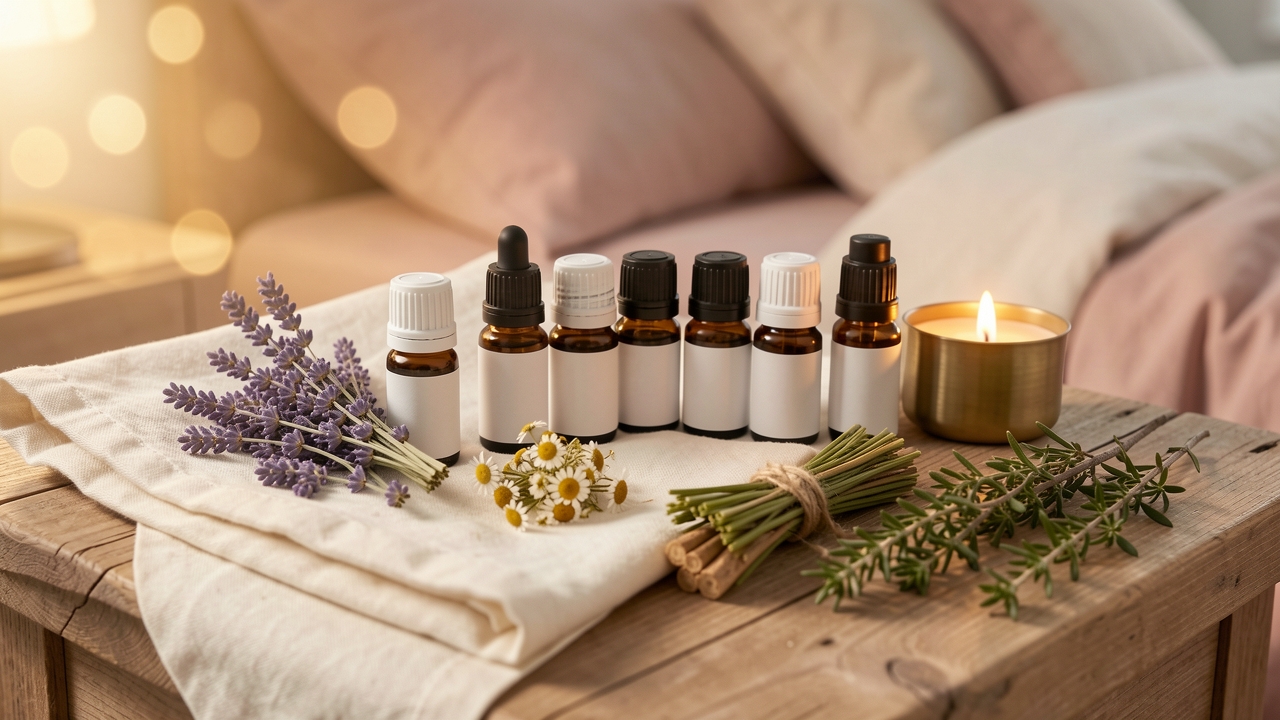
My favourite essential oils for deep sleep: fine lavender, vetiver, Roman chamomile, neroli, marjoram, sandalwood, bergamot. Each has its place depending on the case.
Why aromatherapy works for sleep (real mechanisms)
it’s real energetic work. There are two concrete mechanisms by which essential oils act on sleep:
1. Olfactory pathway: direct to the limbic system
When you inhale an essential oil, molecules reach the olfactory bulb and from there directly to the limbic system — the brain part that regulates emotions, memory and, crucially, the autonomic nervous system. Specific oils activate the parasympathetic (state of calm and repair) in seconds.
This is the only direct pathway to the brain without passing through conscious filters. That’s why a specific oil can induce relaxation even when the mind is racing.
2. Dermal pathway: active compounds in circulation
When you apply a diluted essential oil on the skin, the active compounds cross the skin barrier and enter systemic circulation. Some key compounds for sleep:
- Linalool (from lavender): acts as a mild anxiolytic
- Linalyl acetate (lavender, marjoram): muscle relaxant and sedative
- Apigenin (Roman chamomile): modulates GABA receptors, similar to some mild anxiolytics
- Vetiverol (vetiver): profoundly grounding and sedative effect
3. Neurological anchoring (medium-term effect)
If you use the same oil every night for 2-3 weeks, a neurological anchor is created: just the smell of that oil starts to induce the pre-sleep state automatically. This is what I call “the Pavlov effect of aromatherapy” and is one of the most underrated resources.
The 7 key essential oils for sleep
After 10 years, this is my sleep kit:
1. Fine lavender (Lavandula angustifolia)
The undisputed master. Most studied, safest, most versatile. Effective for almost any type of insomnia. If you only have access to one oil, make it this one.
- Best for: general insomnia, night anxiety, children, pregnant women
- How to use: 4-6 drops in 10ml roll-on + jojoba
- Contraindications: practically none (excellent safety profile)
2. Roman chamomile (Anthemis nobilis)
For sleep with emotional component. Especially useful in very sensitive women, children with night anxiety, postpartum.
- Best for: insomnia + emotional stress, children with nightmares, postpartum
- How to use: 2-3 drops in roll-on (very potent and expensive)
- Contraindications: none specific
3. Neroli (Citrus aurantium)
For insomnia with anxiety and “mind that won’t stop”. One of the most effective oils for stress-related sleep issues.
- Best for: night anxiety, superficial sleep, perimenopause
- How to use: 3-5 drops in roll-on
- Contraindications: none specific
4. Vetiver (Vetiveria zizanioides)
The “anchor” for superficial sleep. Its deep earthy aroma induces a very specific grounding state. Especially useful when you wake at 3-4 am.
- Best for: early waking, superficial sleep, hyperactive mind
- How to use: 2 drops in roll-on (very intense, little goes far)
- Contraindications: none specific
5. Sweet marjoram (Origanum majorana)
For insomnia with muscle tension. Especially useful when you can’t sleep due to contractures, cervical or lumbar pain.
- Best for: insomnia + muscle tension, cervical/lumbar pain
- How to use: 3-4 drops in roll-on
- Contraindications: avoid first trimester of pregnancy
6. Sandalwood (Santalum album or Santalum austrocaledonicum)
For “spiritual” insomnia — when sleep breaks in stages of inner transformation, grief, existential search. It’s the “deepest” oil in my kit.
- Best for: grief insomnia, life transformations, deep perimenopause
- How to use: 3-4 drops in roll-on
- Contraindications: none specific
7. Bergamot (Citrus bergamia)
For insomnia + low mood. A citrus that paradoxically induces calm. Especially useful when there’s sadness or functional depression accompanying insomnia.
- Best for: insomnia + sadness, mild functional depression, low mood
- How to use: 3-4 drops in roll-on
- Contraindications: photosensitising — use ONLY at night, never before sun exposure
5 specific formulas by insomnia type
One of the keys to clinical aromatherapy is adjusting the formula to the type of insomnia. Not being able to fall asleep is not the same as waking early.
Formula 1: sleep-onset insomnia
For those who can’t fall asleep at night (more than 30-45 minutes awake after getting into bed).
Formula: 10ml jojoba + 5 drops fine lavender + 2 drops Roman chamomile + 2 drops marjoram + 1 drop neroli
Application: on wrists, solar plexus and soles of feet, 30 minutes before wanting to sleep. Inhale deeply 5 times from the wrists.
Formula 2: sleep-maintenance insomnia
For those who fall asleep well but wake at 3-4 am and can’t return to sleep. Typically badly regulated cortisol.
Formula: 10ml jojoba + 4 drops lavender + 2 drops vetiver + 2 drops sandalwood + 1 drop neroli
Application: on wrists, nape and soles of feet before sleeping. Keep the roll-on on the bedside: if you wake at 3-4 am, apply 1 drop on wrists and inhale deeply.
Formula 3: insomnia + anxiety
For those who don’t sleep due to mental loops, anticipatory anxiety, ruminating thoughts.
Formula: 10ml jojoba + 4 drops lavender + 3 drops neroli + 2 drops bergamot + 1 drop vetiver
Application: 3 times during evening-night — coming home from work (transition), after dinner, and getting into bed. Combine with .
Formula 4: hormonal insomnia (perimenopause, cycles)
For sleep broken by hot flashes, night sweats, hormonal fluctuations.
Formula: 10ml jojoba + 4 drops lavender + 2 drops rose geranium + 2 drops clary sage + 2 drops sandalwood
Application: on chest (inner sternum), wrists and nape. Specific for perimenopause — see female hormonal aromatherapy.
How to apply correctly (common errors)
Aromatherapy may not work if you apply it wrong. Common errors:
1. Applying only on the pillow
Not the most effective. Skin application + olfactory via close contact (wrists) far exceeds applying on pillow.
2. Too-high concentration
“The more concentrated, the more effect” is false. Above 3-4% (4-6 drops in 10ml) efficacy doesn’t increase — but irritation can.
3. Electric diffusers all night
Better 15-20 minutes before sleeping, then off. Continuous 8-hour exposure can cause olfactory saturation and headache.
4. Using roll-on only when you don’t sleep
Sustained effect requires daily use for 2-4 weeks. Applying it only “in emergencies” loses the neurological anchor which is most powerful.
5. Changing the formula constantly
Anchoring works with consistency. If you change oils every week, you don’t create neurological memory. Use the same formula minimum 4-8 weeks.
6. Using bergamot before sun
Already mentioned: photosensitising. Only at night.
7. Ignoring oil quality
Cheap supermarket oils are usually adulterated or synthetic. They don’t work. Pure, certified, pharmaceutical-grade essential oil is the only real option.
Sleep hygiene: aromatherapy works if the rest does too
Aromatherapy is a powerful tool, but not miraculous. It works within a context of good sleep hygiene:
- Same bedtime and waking time (even weekends)
- No screens 1 hour before sleep
- Dark, cool room (18-20°C ideal)
- No alcohol at dinner (breaks REM phase)
- No caffeine after 2pm
- Light dinner 2-3 hours before sleep
- Movement during the day (no intense exercise 3 hours before sleep)
- Natural light exposure in the morning
- Holistic bath 1-2 times per week
If all this fails, aromatherapy alone won’t solve it.
When insomnia needs more than aromatherapy
honesty and experience:
Cases where aromatherapy may be enough
- Functional insomnia (no diagnosis)
- Intermittent superficial sleep
- Insomnia associated with temporary stress
- Premenstrual insomnia or mild perimenopause
- Mild postpartum insomnia
- Sleep difficulties in children (not severe)
Cases where aromatherapy is complementary but NOT enough
- Chronic clinical insomnia disorder
- Sleep apnea (needs sleep study)
- Restless legs syndrome
- Circadian rhythm disorders
- Insomnia associated with clinical depression or anxiety
- Acute grief insomnia (needs more complete accompaniment — see Reiki for grief)
- Recurrent nightmares in children (more than 3 months)
In these cases, also consult your doctor or sleep specialist.
About my treatments at Arabian Ranches
If you’d like to go deeper into any of the topics covered in this article, at my Arabian Ranches studio I offer several treatments: Reiki with chakra balancing, therapeutic and aromatherapy massages, manual lymphatic drainage, Bach Flower therapy and personalised essential oil formulas, among others.
📋 See the full list and up-to-date pricing at Treatments.
✨ First visit: includes a free 15-minute initial consultation to understand your case and tailor the treatment. New clients also receive a 10% discount on their first treatment.
Book your session here or contact me if you have any prior questions.
Frequently asked questions about aromatherapy for sleep
How long until I notice changes?
The first night can bring immediate relief (you’ll feel more relaxation getting into bed). Sustained change in sleep pattern: 2-4 weeks of consistent use. Deep transformation: 6-8 weeks + sleep hygiene adjustments.
Can I use aromatherapy if I take melatonin or sleep medication?
Yes, it’s compatible. Aromatherapy doesn’t interfere with medication. Many clients combine medication + aromatherapy + habit changes to gradually reduce medication under medical supervision.
Is an electric diffuser worthwhile or better roll-on?
Roll-on always wins for me. More concentrated on the body, more portable, doesn’t saturate the room, more powerful anchoring. Diffuser is complementary and useful 15-20 minutes before sleeping, but not essential.
Does deep sleep come from a single oil or do I need several?
A formula with 3-5 well-selected oils is more potent than a single oil. Formulas work by synergy between components.
← Back to blog · Book a session · Clinical aromatherapy · Essential oils for stress · Female hormonal aromatherapy · Reiki for insomnia · Holistic bath ritual · Reiki for grief