Essential oils for stress and anxiety: the 7 most effective according to a therapist in Dubai
Essential oils are one of the fastest and most respectful tools for regulating the nervous system when stress has accumulated or anxiety appears. They don’t “cure” — but they act in seconds, through the sense of smell directly on the limbic system (the brain area that regulates emotions, memory and stress response), and through the skin when applied diluted. Well chosen, properly dosed and correctly used, they are an extraordinary support for managing daily life — before an exam, in a night anxiety crisis, through the intense rhythm of life in Dubai. In this guide, drawn from my 10+ years of experience as a holistic therapist using clinical aromatherapy, I explain the 7 most effective oils for stress and anxiety, how to use them according to your specific situation, and which blends I always keep ready in my consultation.
The essentials of essential oils for stress and anxiety
Essential oils act in seconds on the nervous system through smell (limbic pathway) and skin
(dermal pathway). The 7 most effective for stress and anxiety are: fine lavender, bergamot,
ylang ylang, Roman chamomile, sandalwood, frankincense and sweet orange. Used properly, they
are safe, compatible with medication and effective even in acute crises.
- Top 7 oils: fine lavender, bergamot, ylang ylang, Roman chamomile, sandalwood, frankincense, sweet orange
- How to use them: diffuser, diluted roll-on, direct inhalation, warm bath
- Action time: by inhalation, in seconds · by skin, in 15-30 minutes
- Compatibility: with anti-anxiety, antidepressant medication, during therapy
- Caution: pregnancy (first trimester), children under 3, citrus photosensitivity
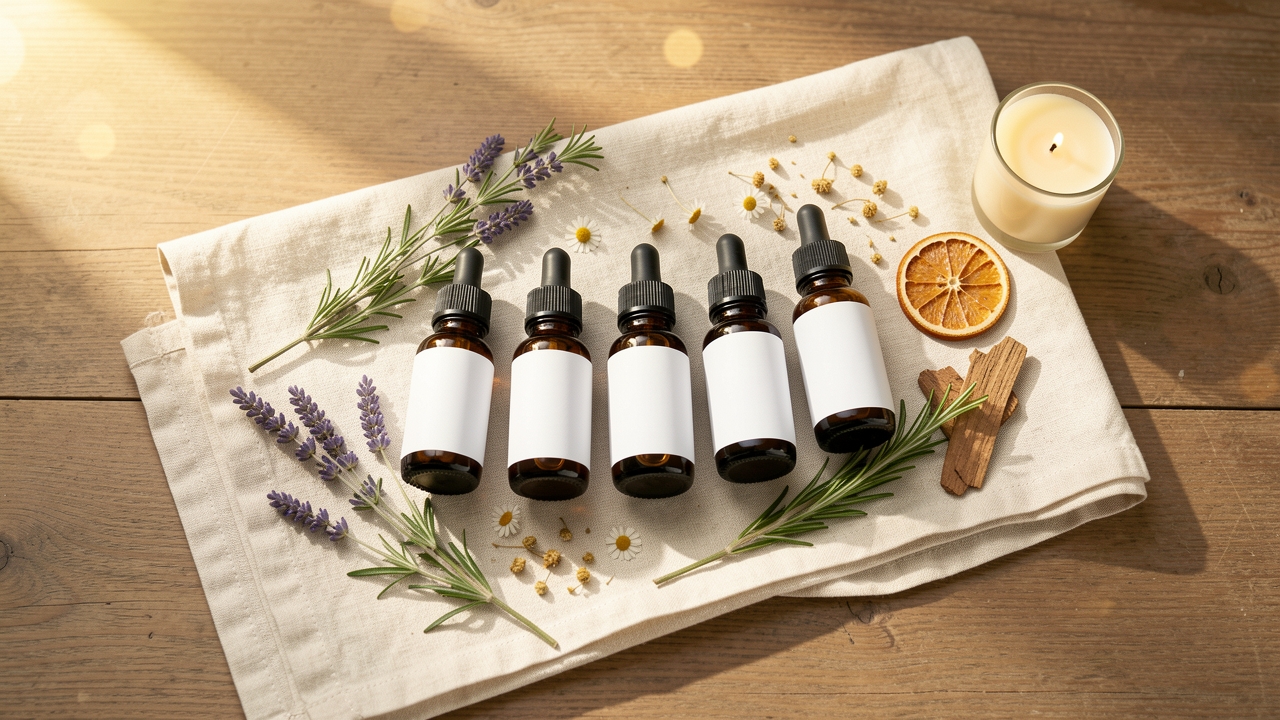
Some of the essential oils I most use in consultation for stress and anxiety: lavender, bergamot, ylang ylang, Roman chamomile, frankincense and sweet orange.
Why do essential oils work so well for stress?
To understand why an essential oil can lower your heart rate in seconds, it helps to know the path it travels.
When you inhale an essential oil, its molecules activate the olfactory receptors in the nose. Those signals travel directly to the olfactory bulb and from there to the limbic system — the brain area that regulates emotions, memory, heart rate and stress response. It is the only sensory pathway that reaches the emotional brain without passing through the cortex first (the rational filter). That’s why a single conscious breath of lavender can calm an anxiety crisis before your mind finishes thinking “I’m in crisis”.
At the chemical level, essential oils act on real neurotransmitters:
- Increase GABA, the inhibitory neurotransmitter (the biochemical basis of many anxiolytics)
- Reduce cortisol, the stress hormone
- Modulate serotonin, linked to mood
- Activate the parasympathetic nervous system, lowering heart rate and blood pressure
This isn’t “herbal magic”: it is plant chemistry entering real interaction with your nervous system. That’s why pure essential oils (not synthetic fragrances) have measurable effects in clinical trials on anxiety, insomnia and stress.
The 7 most effective essential oils for stress and anxiety
After a decade in consultation, these are the oils that appear again and again in my blends for anxiety and stress. I choose them for their clinical effectiveness and their wide safety profile.
1. Fine lavender (Lavandula angustifolia)
The most versatile in the kit. The oil I recommend having at home if you can only have one. Very potent natural anxiolytic, helps sleep, calms the skin, balances. Appears in virtually all my anxiety blends.
- For: generalised anxiety, insomnia, night crises, restless children
- How: diffuser before sleep, 5% diluted roll-on on wrists and solar plexus
- Recommended dose: 3-5 drops in diffuser, 2 drops diluted topically
2. Bergamot (Citrus bergamia)
My favourite for mild mood dips and anxiety crises. Unlike other citrus oils, it doesn’t over-stimulate — it relaxes while lifting. It’s the oil I most use to accompany gentle grief, sadness, anticipatory anxiety.
- For: anticipatory anxiety, sadness, gentle grief, perimenopause
- How: morning diffuser, 3-4% diluted roll-on on wrists
- Caution: photosensitising — don’t apply on skin exposed to sun in the following 12h
3. Ylang ylang (Cananga odorata)
The open-heart oil. Balances blood pressure, calms the nervous system, opens the heart chakra. Ideal for clients with anxiety accompanied by “closed chest”, racing heart, sensation of not being able to breathe deeply.
- For: anxiety with cardiovascular component, stress-related high blood pressure, insomnia
- How: diffuser before sleep (few drops! it’s very intense), 2% roll-on on heart plexus
- Caution: low doses — its aroma is very potent and can cause headache if overused
4. Roman chamomile (Anthemis nobilis)
The oil for intense emotions and children. One of the most expensive on the market, but irreplaceable in very sensitive profiles. Especially useful for clients with a tendency to irritability, explosive crying or reactive anxiety.
- For: irritability, children and babies (very diluted use), anxiety with strong emotional component
- How: 2% roll-on on wrists and soles of feet, diffuser in children’s room
- Caution: safe from 3 months (heavily diluted), gold standard in pediatric aromatherapy
5. Sandalwood (Santalum album)
Deep, grounding, almost meditative aroma. Ideal for clients with the sensation of “floating”, disconnection from the body, spiritual anxiety. It’s the oil I recommend to meditators and to people in vital transition processes.
- For: disconnection, spiritual anxiety, meditation, life transitions
- How: diffuser during meditation, 4% roll-on on wrists and neck
- Caution: none specific — excellent safety profile
6. Frankincense (Boswellia carterii)
Ancestral, deeply spiritual oil. I use it at the close of many Reiki sessions and for energy cleansing. Helps “release” accumulated emotional load and integrate deep processes. Reduces anxiety without sedating.
- For: closing emotional processes, existential anxiety, integration after dense moments
- How: diffuser in rituals, 4% roll-on on wrists, forehead and crown
- Caution: none specific
7. Sweet orange (Citrus sinensis)
The cheeriest, most accessible and most economical of the anxiety oils. Its effect is subtler than the others, but ideal for daily use at home, especially for creating a calm family atmosphere. Works very well with children and as a gateway to aromatherapy.
- For: general home ambience, children, sustained daily use, mild anxiety
- How: diffuser in living room or kitchen, 3-5% roll-on (can be applied generously)
- Caution: slightly photosensitising (less than bergamot)
Specific blends for your situation
Each case asks for its own blend. These are the formulas I most use in consultation that you can prepare (or ask me to prepare) according to what you’re going through:
For night anxiety and difficulty sleeping
Deep calm formula — 10 ml jojoba roll-on at 5%:
– 5 drops fine lavender
– 3 drops Roman chamomile
– 2 drops ylang ylang
Apply on wrists, soles of feet and heart plexus 30 minutes before sleep. 4-7-8 conscious breathing while applying.
For acute anxiety crisis (mild panic attacks)
Emergency roll-on — 5 ml jojoba at 8%:
– 6 drops bergamot
– 4 drops ylang ylang
– 3 drops fine lavender
Carry it with you. Apply on wrists and inhale deeply when you feel activation starting. Combinable with Bach Flower Rescue Remedy.
For anticipatory anxiety (before an event)
Serene courage formula — 10 ml sweet almond roll-on at 4%:
– 5 drops bergamot
– 4 drops sweet orange
– 3 drops sandalwood
Apply 1-2 hours before the event and again just before. Bergamot is photosensitising — apply only on skin not exposed to sun (inner wrist, lower neck).
For chronic stress and mental exhaustion
Reset formula — 10 ml jojoba roll-on at 5%:
– 4 drops sandalwood
– 4 drops frankincense
– 3 drops fine lavender
Apply morning and night on wrists and nape. Continued use for 4-6 weeks. Especially useful for clients in burnout.
The 4 correct ways to use essential oils
1. Diffusion (the most versatile)
You put a few drops in an ultrasonic or candle diffuser, and the molecules disperse into the air. It’s the safest form and the first one I recommend to anyone starting out.
- How much: 3-7 drops per 100 ml water
- How long: 30-45 minutes maximum, then ventilate
- When: before sleep, during meditation, moments of tension
- Don’t use: diffusers in closed rooms with babies under 3 months
2. Diluted topical application (roll-on)
Essential oil diluted in vegetable carrier oil (jojoba, sweet almond, sesame). Concentration 1-5% for general use, up to 10% for acute crises.
- Where: wrists, soles of feet, neck, heart plexus
- When: when you feel activation, before events, before sleep
- Never: apply neat on skin (except lavender and tea tree in very specific situations)
3. Direct inhalation
You open the bottle, breathe deeply 3-5 times from 10 cm distance. The fastest and most discreet way to use an oil — ideal in office, transport, public moments.
- When: anxiety attacks, stress peaks, before public speaking
- Tip: carry a personal inhaler (small roll-on style) prepared with your favourite oil
4. Aromatic bath
Essential oil first mixed with Himalayan salt, milk or vegetable oil (because water alone doesn’t disperse oil). 5-8 drops maximum in a full bath, warm water, 20 minutes.
- For: emotional release processes, moments of heavy tension, end of hard weeks
- Combines with: energy cleansing if you need to release charge
Safety: what you need to know
Essential oils are safe when used properly. The basic rules:
- Never apply neat on the skin (with the specific known exceptions)
- Always dilute in vegetable carrier oil between 1% and 5% for general use
- Tolerance test before first use: one diluted drop in the crook of the elbow, wait 24h
- Pregnancy and breastfeeding: many oils are contraindicated in the first 3 months of pregnancy. Always consult before using any oil in these stages.
- Children under 3: aromatherapy is limited and requires specific training
- Photosensitising citrus (bergamot, lemon, orange, mandarin): don’t apply on skin exposed to sun in the following 12 hours
- Medication: although oils are compatible with most, if you take anticoagulants, antihypertensives or intense psychiatric medication, consult first
- Oil quality: only pure, certified, traceable essential oils (no synthetic fragrances or “aromatic oils”)
My rule in consultation: if I don’t know, I don’t apply. A good therapist never improvises with essential oils.
How I combine essential oils with other therapies
Essential oils enhance their effect when combined with other holistic tools. In my Arabian Ranches consultation:
- Oils + Reiki: the chosen oil reinforces the energetic work — sandalwood for grounding, lavender for calming the nervous system, frankincense for integrating.
- Oils + Bach Flowers: total complementarity. Oils work the chemical dimension, Flowers the vibrational. For anxiety I systematically combine Aspen (Flower) with bergamot (oil).
- Oils + holistic massage: one of the most powerful combinations. The right pressure + the right plant chemistry = deep change in the nervous system.
- Oils + Tibetan singing bowl: the sound opens the energetic channel, the oils anchor the effect at chemical level.
Frequently asked questions about essential oils for stress and anxiety
How long does it take to feel the effect of an essential oil?
By inhalation, the effect on the nervous system is immediate (seconds to minutes). A conscious breath of lavender lowers heart rate in seconds. By skin application, systemic effects appear between 15 and 30 minutes. For chronic processes (sustained anxiety, accumulated stress), sustained use over several weeks is recommended.
Can I take essential oils orally?
I don’t recommend oral use in self-care, except under supervision of a trained clinical aromatherapist. Some oils are irritating to the digestive mucosa or can interfere with medication. Olfactory and diluted dermal pathways are enough for 95% of cases.
Are essential oils addictive?
No, they aren’t pharmacologically addictive. But they can create positive sensory anchors that are very useful: if you always use lavender before sleep, over time just the aroma activates the relaxation response. That isn’t addiction — it’s positive conditioning.
Do essential oils work if I have reduced smell (allergies, COVID)?
The olfactory pathway is reduced, but the dermal pathway still works perfectly. Apply diluted roll-on to wrists and heart plexus — the systemic effect happens just the same.
Are diffusers really safe?
Yes, if they are quality ultrasonic or well-ventilated candle diffusers. Avoid cheap electric diffusers (they heat the oil and degrade its properties) and plug-in air fresheners (not pure essential oils). Ventilate the room after each session.
About my treatments at Arabian Ranches
If you’d like to go deeper into any of the topics covered in this article, at my Arabian Ranches studio I offer several treatments: Reiki with chakra balancing, therapeutic and aromatherapy massages, manual lymphatic drainage, Bach Flower therapy and personalised essential oil formulas, among others.
📋 See the full list and up-to-date pricing at Treatments.
✨ First visit: includes a free 15-minute initial consultation to understand your case and tailor the treatment. New clients also receive a 10% discount on their first treatment.
Book your session here or contact me if you have any prior questions.