The Tibetan singing bowl: what it is, benefits and how I use it in holistic sessions in Dubai
The Tibetan singing bowl is a bronze or metal-alloy instrument from the Himalayas that, when struck or rubbed with a wooden mallet, emits low-frequency sonic vibrations that penetrate the body, calm the nervous system and induce deep states of relaxation. It is not a decorative object: when properly used, it is a therapeutic tool with measurable effects on heart rate, brain activity and muscle tension. In my Dubai consultation, I use it at the opening and closing of every session — Reiki, holistic massage, lymphatic drainage — because the sound of the bowl opens and closes the energetic space of the session in a way no other tool can. In this guide I explain why.
The essentials of the Tibetan singing bowl
The Tibetan singing bowl emits deep sonic vibrations that act directly on the nervous system,
slowing brain activity toward alpha and theta waves — the states of deep relaxation and
meditation. I use it to open and close each holistic session to prepare the energetic field
and to integrate the work done.
- What it is: a Himalayan metal instrument that emits sonic vibrations when struck
- How it works: the sound shifts brain activity into alpha and theta waves (deep relaxation)
- What it’s used for: opening and closing sessions, sound baths, meditation, stress relief
- Measurable benefits: lowers cortisol, reduces anxiety, improves sleep quality
- Full sound bath in Dubai: from AED 250 at Rosana Holistic Studio
- Safety: no general contraindications; caution with pacemakers and first 3 months of pregnancy
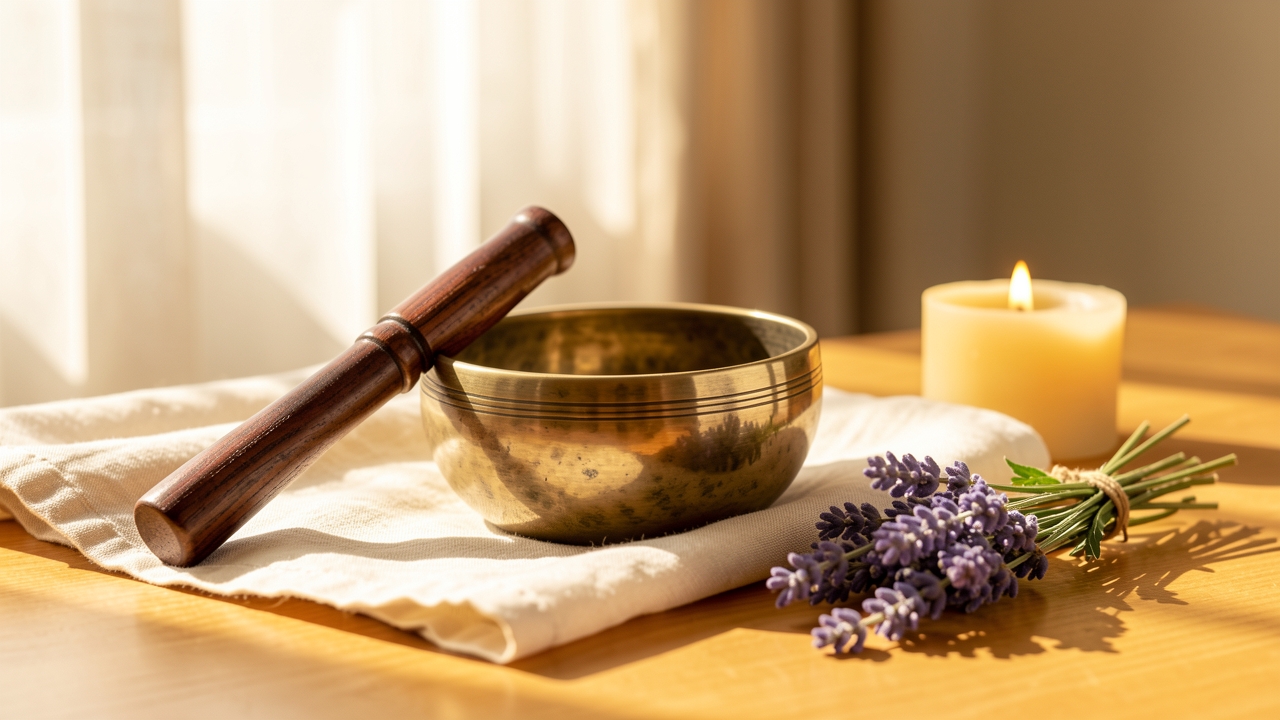
One of the Tibetan singing bowls I use daily in consultation — aged bronze, rosewood mallet and felt cushion.
What exactly is a Tibetan singing bowl?
Tibetan singing bowls are metal-alloy instruments that, when struck with a wooden mallet or rubbed along their rim, emit a sustained, deeply vibrational sound. Something between a low bell and a distant choir.
Their exact origin is wrapped in history and legend. What we know for certain is that they come from the Himalayan region — Nepal, Tibet, Bhutan, northern India — and have been used for centuries in Buddhist and Bön traditions as instruments of meditation, ritual and ceremony. Traditional craftsmanship involves an alloy of 7 metals (gold, silver, mercury, copper, iron, tin and lead), each symbolically associated with a planet of the solar system.
Today there are three main types:
- Authentic antique bowls: pieces 50-200 years old, hand-forged, with deep and irregular sounds. Collectible and valuable.
- Modern artisan bowls from the Himalayas: made today in family workshops in Nepal or northern India, with traditional techniques. This is what I use in consultation.
- Industrial and decorative bowls: mass-produced, mostly in East Asia, with highly variable quality. They may sound pleasant but don’t come close to the vibrational depth of artisan-made ones.
In my consultation I use a collection of 5 Nepalese artisan bowls, each with a different tonal note. I’ve selected them over the years — a “right” bowl for a therapist is something personal: you need to feel how the sound resonates with you before buying it.
How does the Tibetan singing bowl act on the body?
Here is where things get interesting — and where science and millennia-old tradition agree. The sound of the Tibetan singing bowl isn’t “pleasant” by chance: it acts on concrete physiological mechanisms the human body recognises and responds to clearly.
1. Low frequencies penetrate the physical body
Tibetan singing bowls emit sound in the range of low frequencies (between 100 and 500 Hz). These frequencies aren’t only heard: they are felt physically in the body, especially in the chest, abdomen and bones. That’s why many clients describe the experience as “feeling the sound from the inside”. That mechanical vibration relaxes deep muscle and helps release tensions the mind cannot reach.
2. The sound synchronises brain activity
The brain operates in different electrical frequencies depending on its mental state:
- Beta (14-30 Hz): alertness, active thought, anxiety
- Alpha (8-13 Hz): conscious relaxation, calm, presence
- Theta (4-7 Hz): deep meditation, intuition, light sleep
- Delta (0.5-3 Hz): deep sleep, regeneration
The sustained sound of the bowl acts as a vibrational guide that shifts brain activity toward alpha and theta — the states of deep relaxation and meditation. This phenomenon is called brainwave entrainment and is one of the main mechanisms through which sound therapy reduces anxiety and improves sleep.
3. The parasympathetic nervous system activates
Just as with Reiki, the sound of the bowl activates the parasympathetic nervous system, the one of “rest and digest”. Heart rate drops, breathing becomes deeper and slower, cortisol levels fall. It is the physiological basis of the calm state you feel after a sound bath.
4. It stimulates the release of endorphins and serotonin
Preliminary studies — small but consistent — have shown that Tibetan singing bowl sessions are associated with increased endorphins and serotonin, neurotransmitters linked to wellbeing and mood. It isn’t magic: it is the body’s response to a deeply regulating sensory stimulus.
Why I use the Tibetan singing bowl to open and close every session
In my Arabian Ranches consultation, the bowl isn’t a decorative complement. It is a structural part of every session, whether Reiki, holistic massage or lymphatic drainage. And I always use it the same way: to open and to close.
At the opening: to open the energetic space
When a client arrives, she comes from traffic, work, heat, the mental to-do list. Her nervous system is in “doing” mode. If we go directly into a Reiki session without transition, the body takes 20-25 minutes to truly enter parasympathetic state.
When I start the session by sounding the bowl — three soft strikes and a sustained 30-60 second tone — everything shifts. In less than 2 minutes:
- Breathing drops and becomes deeper
- Shoulders visibly lower
- Eyes spontaneously close
- The first sense of “being here” appears
This is what I call opening the energetic space: the sound prepares the working field, makes a clear transition between the “outside world” and the “space of the session”, and tells the client’s nervous system — without words, only vibration — that it can let go.
At the closing: to integrate and return gently
At the end of a session, especially if it has been deep, there is a delicate moment: the client has been in a modified state of consciousness for 60 minutes, and needs to return to everyday life gradually. It isn’t a good idea to get off the table, step into Dubai sun and get in the car straight away — the body needs to reorient.
When I close with the Tibetan singing bowl:
- The sound anchors the work done in sensory memory
- It gives a clear signal of “this is where the session ends” that the system recognises
- It accompanies the gentle return to ordinary consciousness
- Clients often describe the experience as “coming out of a deep sleep naturally, without a jolt”
Many clients tell me that just hearing a Tibetan bowl outside the consultation — in a video, an app, a visit to a temple — instantly brings back the calm sensation of the session. That is the power of sensory anchoring.
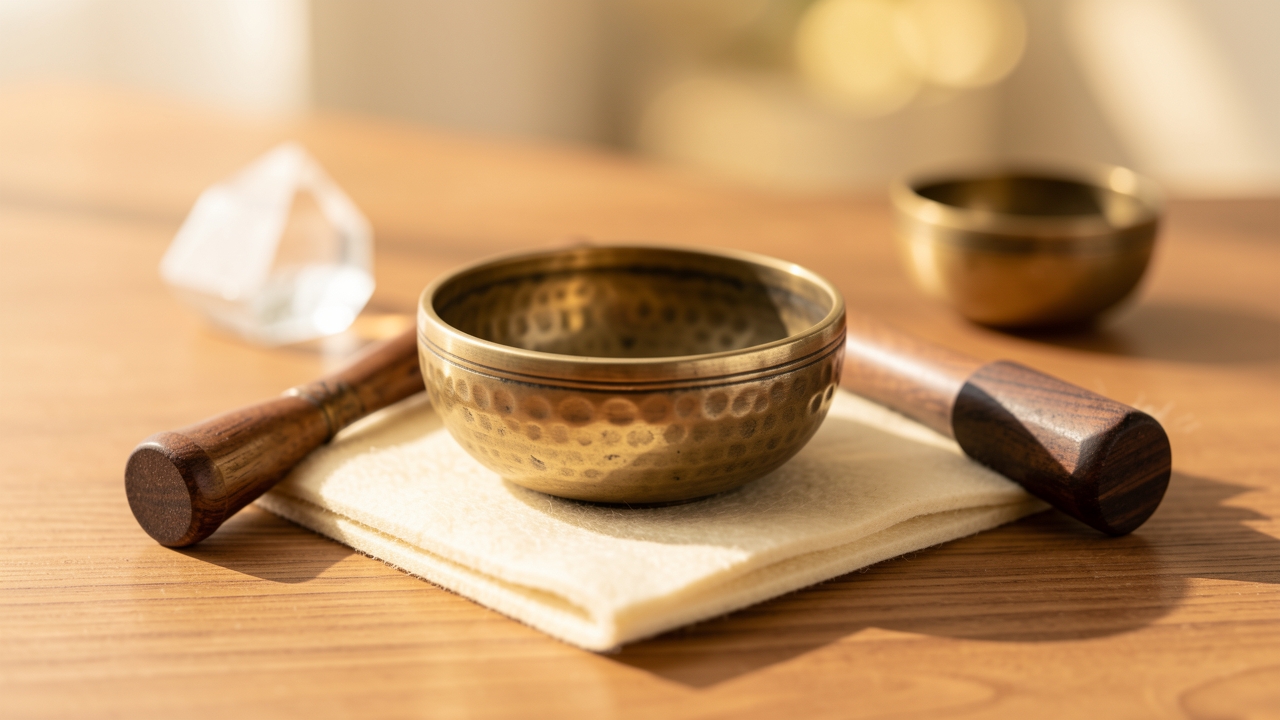
The bowls I use are always artisan-made in the Himalayas. Each has a different tonal note — I choose them according to the chakra I want to support during the session.
What specific issues does the Tibetan singing bowl help with?
After a decade using bowls daily, these are the processes where I see the most consistent results, either as part of a combined session or as an independent sound bath:
Chronic stress and background anxiety
The parasympathetic activation of the bowl’s sound works directly on the physiology of sustained stress. A 30-45 minute sound bath can give more immediate relief than many clients have felt in months.
Insomnia and sleep difficulties
The brainwave shift toward theta — the state preceding deep sleep — explains why so many clients sleep deeply the night after a sound bath. Very useful combined with Reiki for insomnia.
Emotional blocks and grief processes
The bowl’s sound has a very particular capacity to move repressed emotions without needing to talk about them. It is a deeply respectful emotional release tool: it lets what needs to surface come up. Many clients cry during a sound bath — and leave feeling that something has unblocked.
Muscle pain and deep tension
The low frequencies penetrate deep musculature and help release tension that conventional massage cannot reach. That is why I often combine it with holistic massage.
Meditation and spiritual practice
For clients with a meditative practice, the bowl is an extraordinary deepening tool. It shortens the time needed to enter deep meditative states.
Creative processes and mental blocks
Although it may sound curious, several clients who come for creative blocks (writers, artists, therapists) report that bowl sessions unblock something for them and they begin to flow again.
What is a sound bath and how does it differ from a normal session?
Although I use the bowl in all my sessions, I also offer full sound baths as a standalone experience. The difference:
- Holistic session with bowl (Reiki, massage, drainage): the bowl acts as opening and closing, for 5-10 minutes of the total.
- Sound bath (complete session): 45-60 minutes in which the client lies comfortably and I work with several bowls simultaneously — placing them around the body, on the chest, on the abdomen, beside the head — creating an immersive sonic field.
In a sound bath the work is entirely sonic and vibrational. No hands. No oils. Only you, the bowls and the sound. It is one of the most deeply relaxing experiences I can offer.
Book a sound bath session here — new clients receive 10% off.
What does it feel like during a Tibetan singing bowl session?
Each body responds differently, but the most common reports I hear in consultation:
- Clear physical vibration in the body — especially in chest and abdomen
- Sensation of “floating” or “sinking” into the table
- Vivid mental imagery, sometimes with colours
- Emotional release: tears, deep sighs, unexpected laughter
- Deep meditative state without conscious effort
- Soft tingling in hands, feet or scalp
- Sleep during the session (between 30 and 40% of clients)
After the session, what most often happens:
- Deep calm lasting between 24 and 72 hours
- Very restorative sleep that night
- A sense of “having been reset”
- Sometimes, delayed emotional release 12-24 hours later (tears or laughter arriving without obvious cause — completely normal)
- Drink plenty of water afterwards: the body asks for it
Combinations that boost the effect
The Tibetan singing bowl doesn’t compete with other therapies — it amplifies them. The combinations I use most:
- Bowl + Reiki: the combination I use in every session. The sound prepares the nervous system and the laying-on of hands deepens the energetic work. Perfect synergy.
- Bowl + clinical aromatherapy: the bowl works on vibration, aromatherapy on chemistry. Together they create a very complete sensory experience.
- Bowl + holistic massage: low frequencies relax deep musculature before and after the hands-on work.
- Bowl + guided meditation: ideal for people who find it difficult to meditate in absolute silence — the bowl’s sound serves as an anchor.
- Bowl + Bach Flower remedies: the bowl opens the vibrational dimension; the Flowers sustain it at home between sessions.
Safety and contraindications
The Tibetan singing bowl is one of the safest tools in the holistic repertoire. But there are three situations where some nuance applies:
- Cardiac pacemakers: low frequencies, especially with bowls placed directly on the chest, could theoretically interfere. In these cases we don’t place the bowl on the body, we work only with ambient sound — and it’s perfectly safe.
- First trimester of pregnancy: as a general precaution (not based on demonstrated risk), we avoid bowls placed directly on the abdomen during the first 3 months. From the 2nd trimester the bowl can be integrated without issues and is very useful in preparation for birth.
- Extreme sound sensitivity (some people with autism, active migraine, hyperacusis): the volume of the bowl must be adjusted specifically. It’s 100% adaptable.
Outside these three cases, Tibetan singing bowls are completely safe and compatible with any therapy, medication and medical process.
Frequently asked questions about the Tibetan singing bowl
Can I use a Tibetan bowl at home? How do I choose one?
Yes, perfectly. My recommendation if you want one for home:
- Start with a medium-sized artisan Himalayan bowl (between 15 and 20 cm in diameter)
- Listen to it before buying it — the sound has to resonate with you, not with the seller
- Avoid industrial and decorative bowls: they are pretty but have no vibrational depth
- Practise a few minutes each day — on waking or before sleep is ideal
How much does a sound bath cost in Dubai?
In the Dubai market, sound bath sessions range between AED 200 and 600. At Rosana Holistic Studio, a 60-minute individual sound bath session starts at AED 250.
Is the Tibetan bowl the same as a crystal bowl?
No. Crystal quartz bowls are a different, more recent tool, with higher frequencies and a more crystalline tone. I use them occasionally, but my main instrument is the metal Tibetan bowl — the sound is deeper and the vibration more bodily.
Do recorded sound baths (Spotify, YouTube) work?
They work partially. Brainwave entrainment does happen with recorded audio, but the mechanical vibration of the sound in the body — one of the most powerful effects — is only felt with real bowls. As a daily home practice, audio is useful. As a deep therapeutic experience, it doesn’t replace in-person sessions.
Can I do a bowl session if I’ve never done holistic therapy?
Yes, completely. The sound bath is one of the best gateways into the holistic world. No prior preparation is needed, no need to “believe” in anything, and the sensory experience speaks for itself. Many sceptical clients have arrived through a sound bath and stayed.
← Back to blog · Book a session · What is Reiki? · The 7 chakras · Clinical aromatherapy · Bach Flower remedies