Guided meditation with a Tibetan singing bowl: a practical home guide (therapist in Dubai)
Meditation with a Tibetan singing bowl is one of the most accessible ways to start a sustainable meditation practice. Unlike silent meditation — which can be hard when the mind is hyperactive — the sustained sound of the bowl gives you an external anchor the mind can follow without effort. In less than 2 minutes, brainwaves drop from beta (alert) to alpha or theta (deep relaxation) thanks to the brainwave entrainment phenomenon. That’s why it’s the practice I most recommend to clients who say “I can’t meditate, my mind won’t stop”. In this guide, drawn from my 10+ years using bowls in consultation, I share a 10-minute step-by-step practice, 4 specific meditations for what you need, common mistakes to avoid, and how to deepen your practice over time.
The essentials of meditation with a Tibetan bowl
Meditation with a Tibetan singing bowl uses the bowl’s sustained sound as an external anchor to
calm the mind. It works better than silent meditation for beginners because the sound actively
reduces mental activity. 10 minutes a day for 4 weeks measurably changes sleep, anxiety and
mental clarity.
- Minimum useful duration: 5-10 minutes a day
- When it works best: first hour of the morning or last of the night
- What you need: an artisan Tibetan bowl, wooden mallet, quiet space
- How long to feel it: in-session effect immediate; sustained changes in 2-4 weeks
- Ideal for: hyperactive mind, anxiety, insomnia, meditation beginners
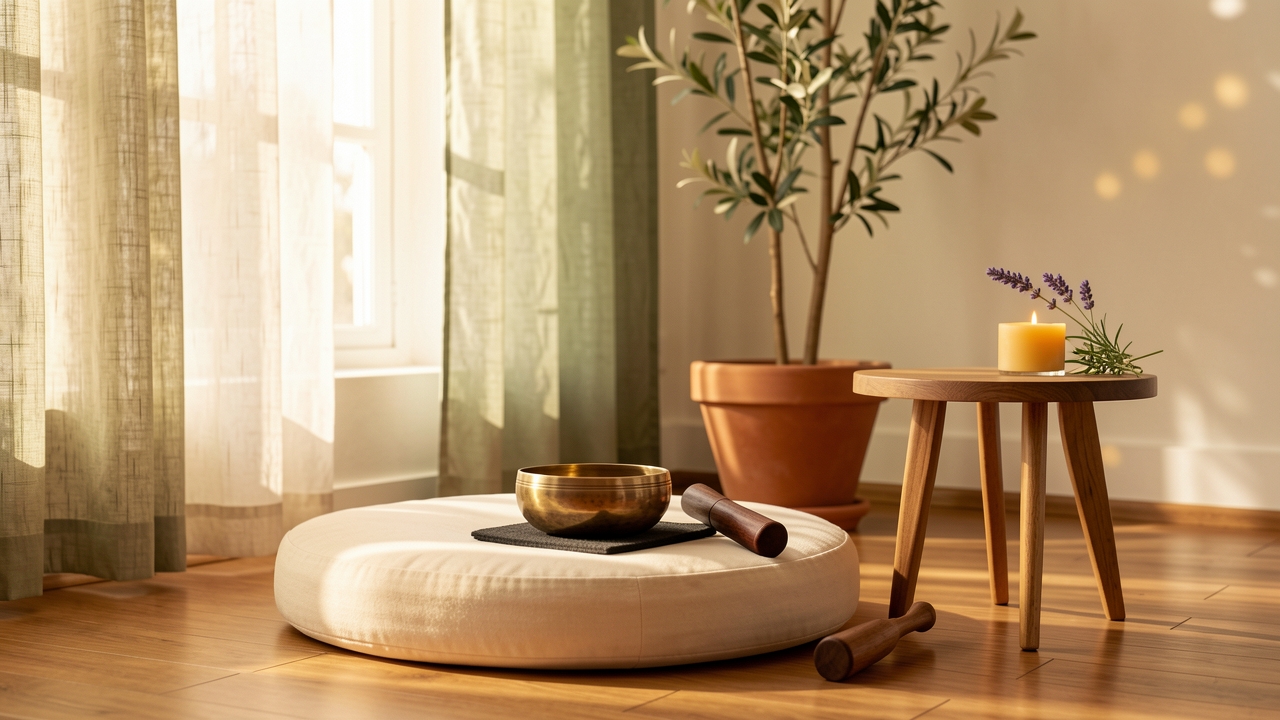
My meditation corner: a cotton cushion, an artisan bronze Tibetan bowl on a felt cushion, and a rosewood mallet. The minimum needed to start a daily practice.
Why meditate with a Tibetan bowl and not in silence?
This is the question I get most, especially from clients who have tried silent meditation and given up thinking “I can’t, my mind doesn’t stop”. The honest, liberating answer: meditating in absolute silence is harder than the wellness culture wants you to believe. For people with very active minds — and that includes most professional women in Dubai — silent meditation can create more frustration than calm.
The Tibetan bowl solves this elegantly. Here’s the physiology behind it:
1. Sustained sound reduces mental activity
When you listen to a Tibetan singing bowl, the brain automatically enters a state of “relaxed attention”. Brainwaves drop from beta (14-30 Hz, active mind) to alpha (8-13 Hz, calm) and then to theta (4-7 Hz, deep meditation) within minutes. This phenomenon is called brainwave entrainment, and is documented in sound therapy studies.
2. Sound is a kinder “external anchor” than the breath
In traditional silent meditation, the breath is used as an anchor point. It’s effective but requires discipline and training. The bowl’s sound does the work for you: the mind wants to follow it, without effort. When the mind wanders, you come back to the sound — you don’t have to “find” the breath.
3. The physical vibration is felt in the body
Unlike app-guided meditation, a real Tibetan bowl emits low-frequency vibrations that are physically felt in the chest, abdomen, bones. That bodily sensation is an additional anchor. Many clients describe the experience as “feeling the meditation in the body” — something they had never experienced with apps or videos.
4. It’s perfect for beginners
If you’ve tried meditating and it hasn’t worked, try with a Tibetan bowl before giving up. The difference is enormous. I’ve seen clients who had been “trying to meditate” for years enter sustained practice for the first time with 10 minutes daily with a bowl.
What you need to start
The minimum, without spending a lot:
1. An artisan Tibetan bowl
Not just any bowl works. Industrial, decorative or very cheap bowls don’t have the vibrational depth you need. My recommendation to start:
- Size: between 12 and 18 cm in diameter
- Origin: artisan from the Himalayas (Nepal, northern India), not industrial Chinese
- Sound: try it before buying — the sound has to resonate with you
- Indicative price: between USD 60 and 180 for a good quality one
More details in my article on the Tibetan singing bowl.
2. A wooden mallet
Usually included with the bowl. Ideally made of rosewood or sandalwood, with a felt or soft leather end.
3. A felt cushion or small pad
To rest the bowl on. If you don’t want to buy one, a folded towel works perfectly.
4. A meditation cushion or comfortable chair
You don’t need the “perfect cushion” — you need something where your back is straight and your knees lower than your hips (or a chair with feet firmly planted).
5. A quiet space for 10 minutes
It doesn’t have to be an “altar” or a decorated corner — a corner of your bedroom or living room with soft light is enough.
What you do NOT need: background music, apps, guided videos, meditation books, expensive equipment. Starting simple is key.
Step-by-step Tibetan bowl meditation (10 minutes)
This is the practice I most recommend to beginners. The one I do myself almost every day.
Minute 0: Preparation
- Sit comfortably, back straight, shoulders relaxed
- Bowl in front of you on its rest
- Close your eyes
- 3 deep breaths in through the nose, out through the mouth
Minutes 1-2: Opening with three strikes
- Take the mallet. Strike the bowl gently once on the outer side
- Listen to the full sound until it fades naturally
- When it has faded, strike a second time
- Repeat a third time
Clients often cry the first time they do this. It’s completely normal — the body recognises the sound and lets go.
Minutes 3-5: Sustained sound
- Strike the bowl once more, gently
- While it’s ringing, rub the rim of the bowl with the mallet in slow circles
- The bowl will start to “sing” — a sustained sound that can last 1-2 minutes
- Full attention on the sound. If the mind wanders, gently return
Minutes 6-8: Meditative silence
- Stop the rubbing
- Let the final sound fade completely
- Stay in the silence that follows
- This post-sound silence is especially powerful — the mind remains in alpha-theta state
Minutes 9-10: Closing with three strikes
- Take the mallet
- Three final strikes, spaced out, letting each one fade completely
- After the last one, stay a few more seconds in silence
- Open your eyes gently
Book an in-person session with me if you want to learn the technique live with a professional bowl — new clients receive 10% off.
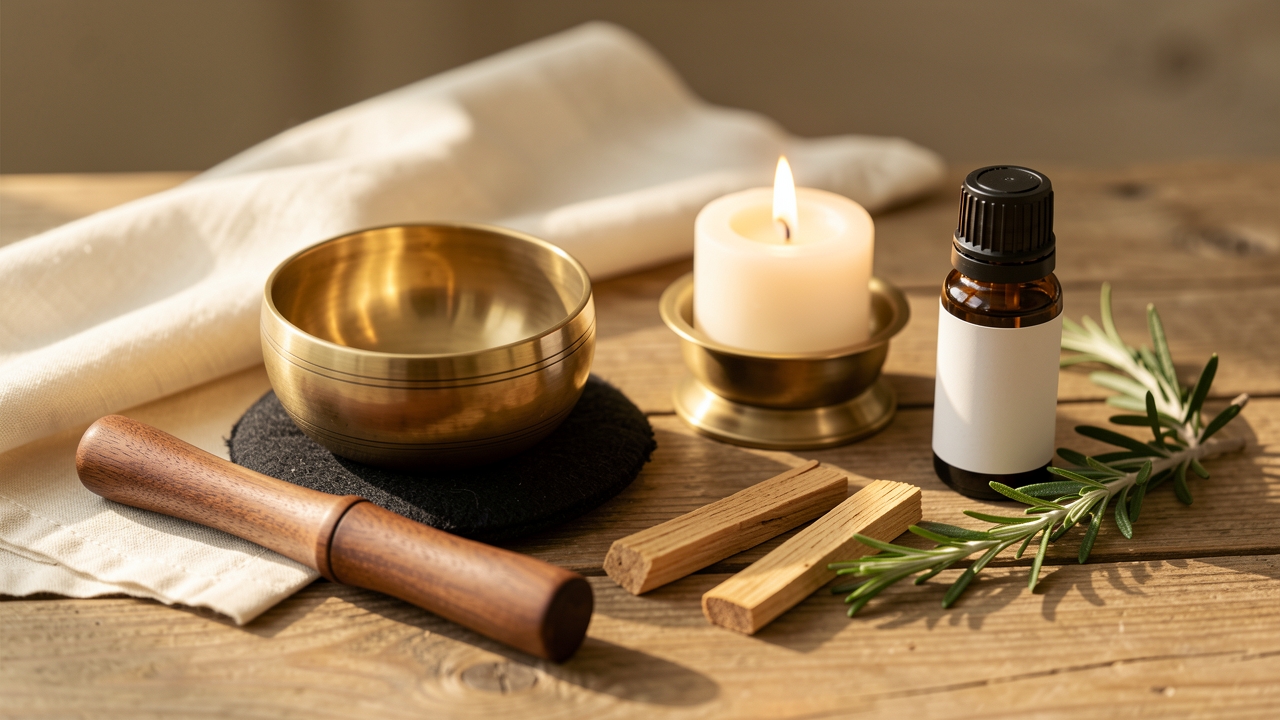
My morning meditation corner: cotton cushion, Tibetan bowl on a rest, a lit candle and a touch of sandalwood aromatherapy. 10 minutes each morning changes the whole day.
4 specific meditations by intention
Once you have the basic practice, you can adapt it to what you need that day.
1. Meditation for calm (anxiety, stressful day)
This is the simplest and the one I use most. The basic 10-minute practice above, but:
- Before starting: set a clear mental intention — “may this meditation bring calm to my nervous system”
- During the sustained sound: visualise the sound as a wave moving from your head to your feet, carrying tension away
- In the post-sound silence: place one hand on your heart and the other on your abdomen
2. Meditation for mental clarity (decisions, “I don’t know what to do”)
Adaptation for when the mind is confused or you have to make a decision:
- Before starting: mentally formulate the question or topic — “what do I need to see clearly?”
- After the 3 opening strikes: let the question rest in the space
- During the sustained sound: don’t search for an answer. Only presence
- In the post-sound silence: clarity often appears without asking. Don’t rush to “decide” — listen to what emerges
3. Meditation for emotional opening (grief, repressed emotions)
For when you know there’s something emotional that needs to come out:
- Before starting: place one hand on your heart
- During the sustained sound: allow any emotion to surface. Tears, laughter, memories — all valid
- In the post-sound silence: breathe slowly, deeply. If emotions continue, let them
- Closing: thank the body for having released
4. Meditation for sleep (insomnia, night anxiety)
Specific evening practice, 5-7 minutes before bed:
- Posture: lying in bed, not sitting
- Bowl: next to the bed, on a side table
- Only 3 strikes (no prolonged rubbing)
- Between strikes: 4-7-8 breathing (inhale 4, hold 7, exhale 8)
- After the last strike: let the silence carry you to sleep
This practice combined with a touch of aromatherapy (lavender, Roman chamomile) profoundly changes the sleep pattern in 2-3 weeks.
Common mistakes to avoid
After a decade teaching this practice, these are the mistakes I see most:
1. Striking too hard
A hard strike produces a high-pitched, shallow sound. Force is not power — the most vibrational sound comes from a gentle strike on the side of the bowl. If your bowl “screams”, you’re striking incorrectly.
2. Moving the bowl while it rings
If you lift or move it, the sound cuts. Always leave it on its rest. Only handle the mallet.
3. Rubbing the rim too fast
To get the sustained sound, rub slowly, with constant pressure. If you go fast or change pressure, the sound breaks.
4. Wanting to “not think”
This is the most common trap. The goal of meditation is not to stop thinking — the goal is not to hook onto the thoughts. Thoughts appear, you recognise them, you return to the sound. That’s the practice.
5. Expecting deep immediate results
The first session will give you a clear sense of calm. But deep change in sleep, anxiety and clarity arrives between week 2 and 4. Trust the process.
6. Meditating only when you’re well
The most common mistake. Daily practice — even 5 minutes on “bad” days — is what creates sustained change. Don’t wait to “have time and be relaxed” to meditate. Meditation is done to reach that state, not from that state.
7. Buying the most expensive or “prettiest” bowl
Buy the one that resonates with you. A well-chosen USD 80 artisan bowl works better than a decorative USD 300 one that doesn’t sound right to you.
How to deepen your practice over time
Once you have the basic practice established (4-6 weeks doing it), you can deepen:
Add more bowls
Working with 2 or 3 bowls in different notes greatly amplifies the depth. A bass bowl for the body, a mid bowl for the heart, a treble for the head. It’s what I do in my in-person sound bath sessions.
Combine with aromatherapy
A touch of frankincense, sandalwood or lavender during practice creates a very powerful sensory anchor — over time, just smelling that aroma activates the meditative state.
Combine with crystals
An amethyst in the left hand, a clear quartz in the right. The amethyst calms; the quartz amplifies the intention.
Add chakra work
Once familiar with the chakras, you can dedicate each day of the week to one (Monday root, Tuesday sacral, etc.) and orient the meditation to the corresponding chakra.
Attend in-person sessions
Group sound baths or individual sessions with professional bowls greatly deepen the personal practice. What you learn in person you can later replicate at home with much higher quality.
In-person sessions with me in Dubai
In my Arabian Ranches studio I offer two types of bowl sessions:
Lying on my treatment table, I work with 5 artisan bowls placed around your body and on specific points (chest, abdomen, beside the head). The experience is very different from personal practice — deeper, more complete, more restorative. Especially recommended when you’re in a moment of high tension, after an intense period, or as an introduction to the world of therapeutic sound.
Frequently asked questions about Tibetan bowl meditation
How long do I need to meditate daily to feel changes?
10 minutes a day for 4 weeks is the minimum I recommend to start noticing sustained changes (better sleep, less emotional reactivity, more clarity). Some clients with 5 minutes daily also notice clear difference, but 10 is the sweet spot.
Can I meditate with a bowl if I have pets that get nervous?
Start with very gentle strikes to see how your pet reacts. Most dogs calm down with the bowl’s sound (in fact, many curl up next to you during practice). Some cats may be more sensitive at first — if your cat leaves, that’s fine. After a few weeks, they usually get used to it.
Is meditating with a real bowl the same as with a bowl audio?
Not exactly. The audio activates brainwave entrainment the same way, but it loses the physical vibration in the body — one of the most powerful effects. For beginners, audios can work to get used to it, but practice with a real bowl is clearly superior.
About my treatments at Arabian Ranches
If you’d like to go deeper into any of the topics covered in this article, at my Arabian Ranches studio I offer several treatments: Reiki with chakra balancing, therapeutic and aromatherapy massages, manual lymphatic drainage, Bach Flower therapy and personalised essential oil formulas, among others.
📋 See the full list and up-to-date pricing at Treatments.
✨ First visit: includes a free 15-minute initial consultation to understand your case and tailor the treatment. New clients also receive a 10% discount on their first treatment.
Book your session here or contact me if you have any prior questions.
← Back to blog · Book a session · The Tibetan singing bowl · What is Reiki? · Reiki for insomnia · Holistic crystals · The 7 chakras · Essential oils for stress