Holistic massage vs traditional massage: differences and which to choose (guide from a therapist in Dubai)
Traditional massage works on the physical body — muscles, fascia, joints — with techniques focused on relieving muscular tension, improving circulation and reducing pain. Holistic massage starts from the same point but goes further: it integrates the physical plane with the emotional and the energetic, using specific essential oils, conscious breathing rhythms, field reading and, depending on the case, tools such as the Tibetan singing bowl or chakra work. In this guide, drawn from my 10+ years of experience as a therapist in Dubai, I explain what each offers, in which cases one works better than the other, and how I do holistic massage in my Arabian Ranches studio.
Key differences between holistic and traditional massage
Traditional massage treats the physical body. Holistic massage treats body, emotion and energy
as a single system. Traditional is ideal for specific knots and sports recovery. Holistic is
the choice for chronic stress, anxiety, emotional blocks and when you want a deeper, restorative
experience.
- Traditional massage: musculoskeletal work, medium-high pressure, local focus on problem areas
- Holistic massage: integrates body + emotion + energy, variable pressure, clinical aromatherapy, breath rhythm
- Typical duration: traditional 50-60 min · holistic 75-90 min
- When to choose traditional: specific knots, sports recovery, localised muscular pain
- When to choose holistic: chronic stress, anxiety, emotional exhaustion, complete care cycle
- Session in Dubai: holistic massage from AED 400 at Rosana Holistic Studio (Arabian Ranches)
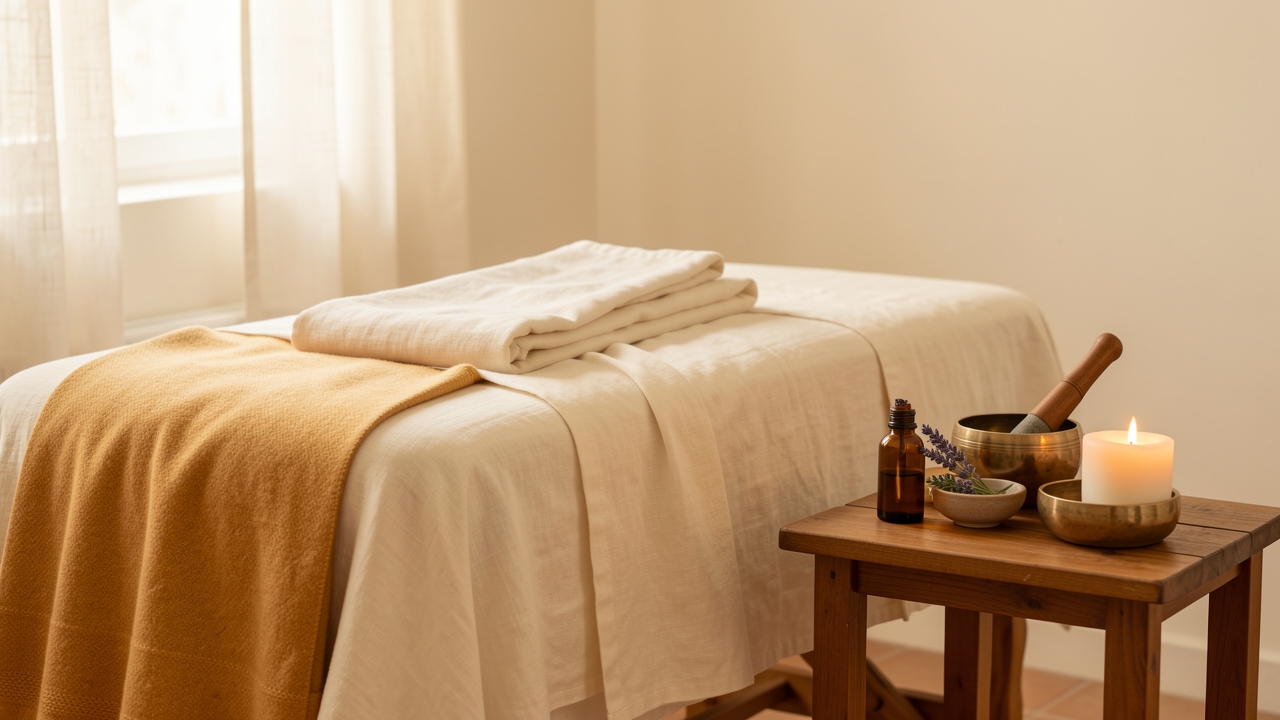
My treatment table prepared for a holistic massage session: linen sheet, carrier oil, personalised blend bottle and Tibetan singing bowl ready.
What is traditional massage?
Traditional massage — also called therapeutic, Swedish or sports massage depending on the school — focuses on manual work on the physical body. The goal is clear: relieve muscular tension, improve circulation, release knots, restore mobility. The main techniques:
- Effleurage: long gliding strokes to warm the tissue
- Petrissage: deep kneading of the musculature
- Friction: localised work on knots and contractures
- Percussion: rhythmic techniques to activate circulation
- Vibration: short movements to release fascia
A typical session lasts 50-60 minutes and focuses on the areas the client identifies as problematic: shoulders, lower back, legs. Pressure is medium to high, according to tolerance.
When traditional massage is the right choice:
- Localised muscular knots (neck, trapezius, lumbar)
- Sports recovery after intense physical effort
- Postural tension (office work, hours at the computer)
- Acute muscular pain without strong emotional component
- Physical maintenance between physiotherapy sessions
In Dubai, this type of massage is very present in hotel spas and physiotherapy centres. It does its job — and does it well — when what you need is pure physical work.
What is holistic massage?
Holistic massage starts with the physical body but doesn’t stay there. It recognises that body, emotion and energy are a single system, and works the three planes in a single session. Its origin lies in the integration of European manual traditions with Eastern energetic therapies — Ayurveda, Thai massage, Californian techniques from the 70s — and it has consolidated as one of the most complete modalities of contemporary holistic care.
What sets holistic massage apart from traditional:
1. A deeper initial conversation
Before starting, I dedicate 10 to 15 minutes to understanding how you arrive today: not only what hurts physically, but also how you feel emotionally, what’s in your head, how your sleep and vital energy are. This conversation defines the entire session.
2. Integrated clinical aromatherapy
Holistic massage always includes clinical aromatherapy: pure essential oils selected specifically for your case, mixed in a carrier oil suited to your skin. It isn’t “the scent of the day” — it’s a formula made for you, that session.
3. Variable pressure and conscious breathing
The pressure isn’t constant. It adapts in intensity according to what the body asks for, following the client’s breath rhythm. In areas where I sense more tension, I sustain pressure synchronised with the exhale, which releases far more deeply.
4. Energetic reading during the work
During the massage I perceive where there is emotional charge, where there is energetic blockage, where the body “speaks”. It’s a layer of information that traditional massage doesn’t address — and that completely changes the depth of the work.
5. Opening and closing with the Tibetan singing bowl
Every holistic session starts and ends with the sound of the Tibetan singing bowl. The sound at the start prepares the nervous system to let go; at the end, it anchors the work and returns the client to ordinary consciousness gently.
6. Optional energetic integration
Depending on the case, I integrate elements of Reiki, work on specific chakras, or aura cleansing. A holistic session for a client with recent grief isn’t the same as for one with postural tension — and the session is designed accordingly.
7. Closing with personalised guidance
After the session I leave you warm water, we talk about what you felt and I give you a couple of specific guidelines for the following days: hydration, food choices, rest, aromatherapy for home.
A typical session lasts 75-90 minutes. It’s longer than a traditional massage because it does more — and because when the body truly allows itself to let go, it isn’t rushed.
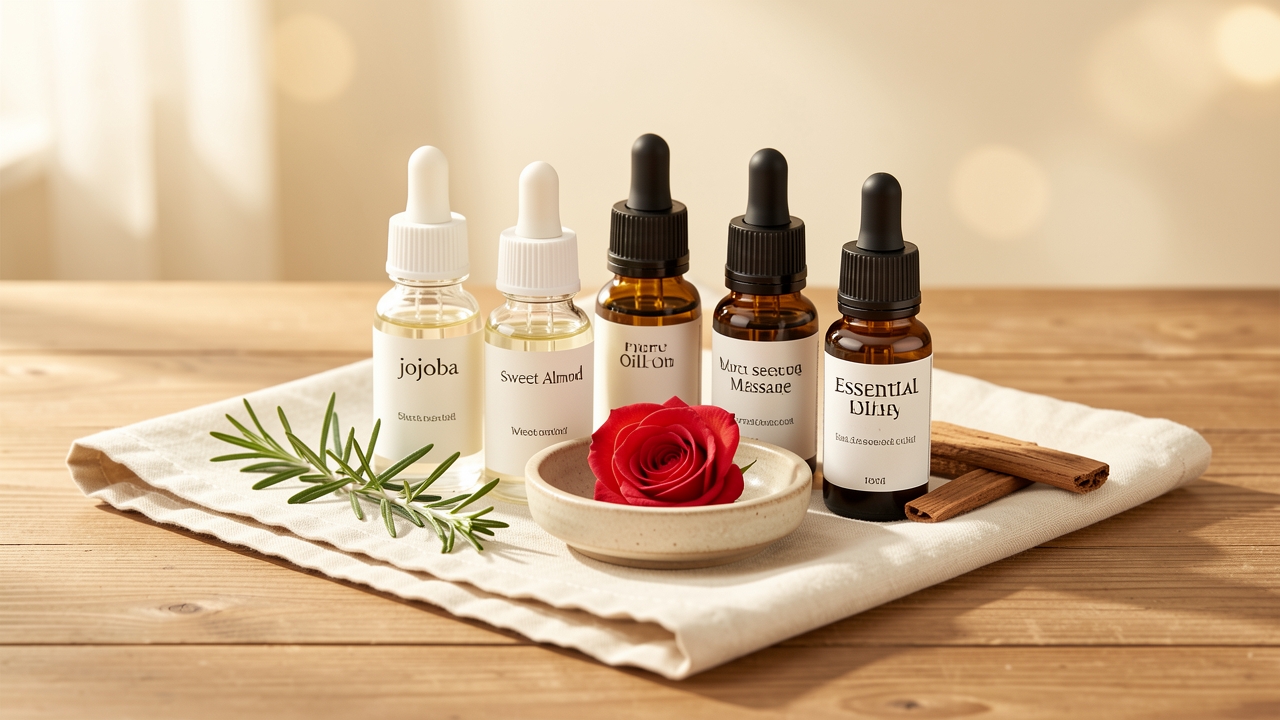
Some of the oils I use in consultation: jojoba and sweet almond as carriers, and pure essential oils of lavender, rose geranium, sandalwood and frankincense for personalised blends.
Comparative table: holistic vs traditional
| Aspect | Traditional massage | Holistic massage |
|---|---|---|
| Focus | Physical body | Body + emotion + energy |
| Typical duration | 50-60 min | 75-90 min |
| Oils | Neutral oil | Personalised clinical aromatherapy |
| Pressure | Medium-high, constant | Variable, synchronised with breath |
| Initial conversation | Brief, about physical pain | Deep, about integral state |
| Emotional work | Not included | Integrated in every session |
| Energetic reading | No | Yes (chakras, aura) |
| Opening/closing | Direct | Tibetan bowl + closing ritual |
| After the session | Sense of relieved body | Sense of “having been reset” |
| Ideal for | Knots, sports recovery | Chronic stress, anxiety, emotional blocks |
| Dubai price range | AED 250-500 | AED 400-800 |
When to choose one or the other?
This is the most practical question. My honest answer, based on years accompanying clients:
Choose traditional massage if:
- You have a specific localised knot (neck, shoulder, lower back) and want pure physical work
- You are in sports recovery or have a demanding physical routine
- You want shorter duration (50-60 min) due to schedule or budget
- Your general emotional state is stable and you only need to resolve physical tension
- You want higher frequency (weekly, fortnightly) without integrated process
Choose holistic massage if:
- The stress you carry is chronic, sustained, with emotional component
- You feel your body is heavy but don’t know exactly where it hurts
- You’ve gone months without feeling truly rested even when you sleep
- You’re in an important life transition (relocation, separation, motherhood, grief)
- You’re looking for an experience that is at once deeply relaxing and transformative
- You want each session to be a complete care event, not just a physical routine
In my Dubai consultation, 80% of clients who come for holistic massage didn’t arrive due to physical pain — they arrived because something in their body was asking for deeper care than the hotel spa was giving.
How I do holistic massage
Every session is different because every body arrives differently. But this is the structure that holds my work:
- Initial conversation (10-15 min, no charge): how you arrive, what you want to work on, what you carry emotionally, how your sleep is, your energy, your cycle if applicable.
- Space preparation: adjusted temperature, linen sheet, oil blend prepared on the spot based on what your energy asks for that day.
- Opening with Tibetan singing bowl: 1-2 minutes of sound so the nervous system enters rest mode before starting.
- Holistic massage (60-75 min):
- I begin with long glides to connect with the whole body
- I work loaded areas with pressure synchronised with your breath
- I integrate fascial movements and techniques inspired by Californian massage
- If I sense energetic block, I move to still-hands work (integrated Reiki)
- On reflex areas (soles of the feet, scalp) I work with specific techniques
- Closing with Tibetan singing bowl: 1-2 minutes to integrate.
- Rest (5-10 min): I leave you alone on the table. I don’t rush you up.
- Closing conversation with warm infusion: we talk briefly about what you felt and I give you guidelines for the following days.
Book your first session here — new clients receive 10% off.
Combinations I most recommend
Holistic massage is greatly enhanced when combined with other tools. The combinations I use most:
- Holistic massage + Reiki: the massage releases the physical load, the closing Reiki integrates the energetic work. One of the most complete combinations.
- Holistic massage + manual lymphatic drainage: post-partum, post-surgery, fluid retention. But they should alternate in different sessions, not within the same one.
- Holistic massage + clinical aromatherapy: they’re already integrated — but we can take the aromatherapy home with a personalised roll-on.
- Holistic massage + Bach Flower remedies: the Flowers sustain between sessions the emotional opening the massage awakens.
- Holistic massage + one-off aura cleansing sessions: for people in dense moments or professions with intense human contact.
How many sessions do you need?
Depends on the goal:
- For one-off care (an intense week, an exhausting trip, a stressful event): 1 session may be enough.
- To reverse chronic stress: cycle of 4-6 sessions spaced 1-2 weeks apart, then monthly maintenance.
- To accompany an important life transition: cycle of 6-8 sessions over 3 months.
- General maintenance: one session every 3-4 weeks, indefinitely. Most of my regular clients live this as preventive care, like going to the dentist or doing sport.
A one-off session gives immediate relief. What changes things long-term is continuity.
Frequently asked questions about holistic vs traditional massage
Is holistic massage an alternative to physiotherapy?
Not exactly. If you have a specific muscular injury, a disc herniation, a tendinopathy or any structural problem, the first step is physiotherapy. Holistic massage accompanies that process but doesn’t replace it. If your problem is chronic stress, anxiety, exhaustion or tension without structural cause, holistic massage is an excellent choice.
How much does a holistic massage cost in Dubai?
In the Dubai market, prices range between AED 400 and 1,000 per session, depending on the venue and duration. At Rosana Holistic Studio, a 75-minute holistic massage starts at AED 400, with a 10% discount on the first session and package pricing for 5-session processes.
Is it safe during pregnancy?
Yes, with adaptations. I do prenatal holistic massage from the second trimester, with specific positions (on your side), oils suited to pregnancy, and reflex zones I avoid. In the first trimester I only recommend it in specific cases and with your gynaecologist’s clearance.
Can I have holistic massage if I have medical issues?
Most processes are compatible. Clear contraindications: acute infections with fever, active venous thrombosis, untreated cancer, very recent surgeries without medical clearance. If you have any active medical process, tell me in the initial conversation and we decide together whether the session is appropriate or whether to wait.
How do I choose between holistic massage, Reiki or lymphatic drainage in my case?
If in doubt, message me on WhatsApp with a couple of lines about how you are and what you’re looking for. I don’t charge for initial orientation — my work is for the session to be the right one for you. Sometimes what the client thought she needed isn’t what her body is asking for, and it’s worth talking before booking.
← Back to blog · Book a session · What is Reiki? · Manual lymphatic drainage · Clinical aromatherapy · Tibetan singing bowl