Postpartum Reiki: how to care for the mother after birth (guide from a therapist in Dubai)
The postpartum period is one of the most demanding and most invisible times in a woman’s life. The body has just sustained an enormous transformation — pregnancy, birth, a sharp hormonal drop, breastfeeding, fragmented sleep — and culture expects you to “be yourself again” within a few weeks. But the postpartum is not a return to something previous: it is a process of deep reorganisation in which the mother needs specific, sustained and understanding care. Reiki is one of the most respectful and effective tools to accompany that process: it asks nothing of you, adds no burden, and works precisely on what the postpartum body needs — nervous system, hormonal balance, emotional integration. In this guide, drawn from my 10+ years of experience working with women in postpartum in Dubai, I explain how Reiki helps, when to start depending on your type of birth, what a postpartum-specific session includes, and what results you can expect.
The essentials of postpartum Reiki
Postpartum Reiki helps the mother’s body integrate the transformation of pregnancy and birth:
it regulates the exhausted nervous system, accompanies the hormonal drop, sustains the emotional
process (including baby blues) and supports physical recovery. It can be started from the first
week with a vaginal birth and from week 4-6 with a C-section (with medical clearance).
- When to start: first week with vaginal birth · 4-6 weeks with C-section
- What it helps: exhaustion, baby blues, anxiety, insomnia, physical recovery
- Recommended frequency: cycle of 5 sessions spaced 7-10 days apart
- Compatible with: breastfeeding, postpartum medication, regular medical care
- The baby: can be with you during the session, no problem
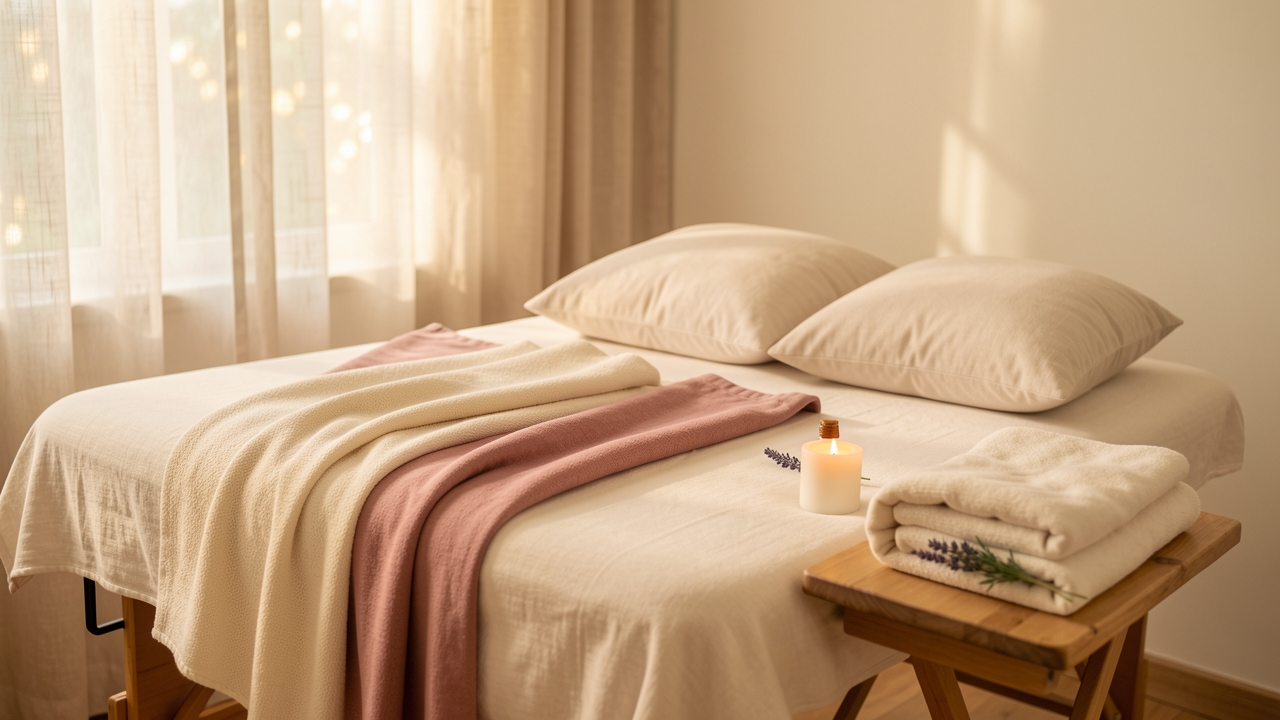
My treatment table prepared for a Reiki session after birth: warm cotton blanket, soft pillows so you can settle comfortably according to your body, low light and carefully adjusted temperature.
Why does the postpartum need specific holistic care?
In conventional medicine, postpartum is usually closed at 6 weeks with a gynaecological check-up. If everything is fine, it’s considered “full recovery”. But women who actually live the postpartum know it isn’t so: the transformation lasts much longer, and goes far beyond the physical. The postpartum is, in reality, a 6 to 12 month process that touches five layers at once:
- Physical body: healing, pelvic floor, abdominal recovery, fatigue, breastfeeding
- Hormonal system: sharp drop in oestrogens and progesterone, high prolactin, fluctuations that can last months
- Nervous system: sustained hyper-alertness (listening for the baby constantly), fragmented sleep, elevated cortisol
- Emotional plane: new identity, grief for the previous self, bonding with the baby, baby blues, anxiety
- Spiritual plane: the background question about who you are now, what you want, how your life reorganises
Caring only for the physical body — check-ups, pelvic floor exercises, nutrition — is necessary but insufficient. Mothers who receive support across the five layers (the 5 energy bodies) live the postpartum very differently from those who carry the whole weight alone.
In my Dubai consultation, postpartum is one of the most frequent reasons women come. Especially expats who are far from their family network, without the cultural support webs they would have in their country of origin.
How does Reiki help the mother in postpartum?
Reiki is one of the most suitable tools for postpartum because it asks nothing of you. It doesn’t ask you to talk, to move, doesn’t add tasks. You simply let yourself be, and the body receives. For an exhausted mother, that alone is enormous.
What Reiki specifically works on in postpartum:
1. Regulation of the exhausted nervous system
Postpartum mothers live in sustained hyper-alertness: listening for the baby even while asleep, attending to constant demands, sleeping in short fragments. This keeps the sympathetic system (“fight or flight”) chronically activated and depletes reserves. Reiki deeply activates the parasympathetic system (“rest and digest”), allowing the body real recovery — something fragmented sleep cannot achieve alone.
2. Accompanying the hormonal drop
In the early postpartum weeks, oestrogens and progesterone drop drastically, while prolactin and oxytocin rise to support breastfeeding. This hormonal cocktail explains much of the baby blues, the heightened emotional sensitivity, the easy tears. Reiki doesn’t “regulate” hormones like a medication, but by balancing the autonomic nervous system, it accompanies the peaks and drops with less turbulence. Clients describe feeling “more stable” from the first session.
3. Emotional integration of birth and motherhood
Every birth leaves an emotional imprint. Rapid births, long births, unplanned C-sections, medical emergencies, difficult breastfeeding — all of this needs to be integrated. Reiki creates a safe and respectful space for those emotions to surface at their own pace, without forcing. Many clients cry in their first Reiki session after birth — not because they are sad, but because they finally have a space to release.
4. Supporting the mother-baby bond
When the mother is in parasympathetic mode, the baby feels it and calms too. It is an observable and very clear effect: clients who come regularly to postpartum Reiki often report their babies sleep better on the nights after the session. it’s real energetic work — it’s shared physiology.
5. Physical recovery of the postpartum body
Reiki accelerates physical recovery by activating the body’s repair mode. Healing (including C-section, once the wound has closed), pelvic floor recovery, elimination of excess fluids (which combines beautifully with manual lymphatic drainage). The body recovers its capacity to regenerate when the nervous system allows it to.
6. Reconnecting with your body as a woman
A topic rarely spoken about: many women don’t recognise themselves in their postpartum body. It isn’t only about “getting back to size” — it’s about inhabiting a different body. Reiki, by working gently from presence and respect, helps you inhabit your body again from calm. Many clients describe it as “feeling at home in my skin again”.
When to start Reiki after birth?
One of the questions I get most. The answer depends on the type of birth:
Vaginal birth without complications
You can start from the first week postpartum. Reiki is completely non-invasive, there is no physical manipulation, and in fact the sooner you start, the better: the nervous system is enormously grateful for parasympathetic rest while still in full adaptation. I’ve done sessions with mothers whose babies were 5 days old, with no problem.
C-section (without complications)
The usual recommendation is to wait 4-6 weeks and to receive your gynaecologist’s clearance. Before then, very gentle sessions can be done focusing on head, hands and feet — completely avoiding the abdominal area — if the mother needs it for extreme exhaustion or high anxiety. Once the wound has healed, we can work the entire body, including the abdominal area very carefully.
Difficult births or birth trauma
Here Reiki is especially valuable. Births with complications, emergencies, unplanned C-sections, forceps, haemorrhages, NICU admissions — all of that needs to be integrated at the nervous system level. A very early session (first or second week, even with C-section, working only head-hands-feet) can greatly help begin to process what was lived. Many mothers at this point come with specific Bach Flower remedies (Star of Bethlehem for the shock of traumatic birth) in parallel.
Late postpartum (3-12 months)
Many mothers arrive at my consultation months after giving birth, exhausted and with the feeling that they “should already be fine”. I want to say to you: it’s never too late. Postpartum Reiki can be started at any point in the first year (and beyond), and the body responds just as well. In fact, mothers at 6 months often have a greater clarity about what weighs on them and what they need to work on — and that enriches the session.
My postpartum Reiki protocol at my studio
In my Arabian Ranches consultation, postpartum Reiki sessions have a specific structure. It is not the same as for or for chronic pain:
- Extended initial conversation (15-20 min): how your birth went, how you are today, how your sleep is, your breastfeeding, your energy, your emotional state. No rushing. It’s the moment when many mothers cry for the first time with someone.
- Body-aware space preparation: I adjust the table, add extra pillows (especially under the knees if the lumbar or abdominal area is uncomfortable), warm blanket. Your postpartum body needs to feel held.
- Very gentle aromatherapy: lavender + neroli + mandarin are the oils that respond best in postpartum. Low concentration, nothing saturating.
- Opening with Tibetan singing bowl: very soft. The postpartum nervous system is exhausted — it doesn’t need strong stimuli.
- Reiki session adapted to your moment: if you’re in the early weeks, I completely avoid pressure on the abdomen. Deep work on head, solar plexus (emotions), heart (bonding and baby blues), pelvic area energetically (without physical contact if there’s an episiotomy or recent C-section).
- Aura cleansing: postpartum leaves a lot of absorbed charge — emotions, others’ comments, others’ expectations. A very gentle aura cleansing releases what isn’t yours.
- Closing with Tibetan singing bowl: integrates the work.
- Respectful rest (10 min): I don’t rush you to get up. In postpartum, this final rest is a fundamental part of the session.
- Concrete guidelines for home: hydration, sleep when possible, a couple of simple self-care gestures, an oil blend to take with you.
Book your first session here — new clients receive 10% off.

When you come in postpartum, everything is designed so your body doesn’t have to hold itself up: extra pillows, blanket, gentle oils, space to cry if you need to.
How many sessions do you need?
My honest answer, based on what I see every week in consultation:
- Immediate postpartum (first month): if possible, 1-2 sessions in the first 3 weeks. The body is processing enormously and deep parasympathetic rest is gold.
- First trimester postpartum recovery (weeks 4-12): cycle of 5 sessions spaced every 7-10 days. It’s the most recommended cycle and the one that gives me the best results.
- Late postpartum (3-12 months): cycle of 5 sessions every 1-2 weeks + monthly maintenance.
- Holistic mother’s wellbeing maintenance: once balance is recovered, one session every 3-4 weeks during the first year is precious preventive care.
After the first session, most of my postpartum clients report:
- Deeper sleep that night (even with a baby who wakes)
- More capacity for emotional regulation the following days
- A sense of “inhabiting the body” again
- More patience with the baby and with herself
Reiki as support for baby blues and postpartum depression
It’s worth distinguishing two things:
Baby blues
It’s completely normal, happens to 50-80% of mothers, usually appears between day 3 and day 10 postpartum and resolves on its own within a few weeks. Caused fundamentally by the hormonal drop. Reiki is ideal here: it accompanies the process, smooths it, regulates the nervous system and helps integrate the emotions that surface. It doesn’t “cure” baby blues — it makes it much more bearable.
Postpartum depression
It’s something very different. It’s a clinical condition that needs specialised medical and psychological care. Reiki can be a very valuable complementary support, but never a substitute for the main treatment. If you feel you’ve been carrying deep sustained sadness for more than 2-3 weeks, lack of connection with the baby, negative ideation or severe loss of functionality, please speak to your gynaecologist or family doctor immediately. Postpartum depression is real, treatable and nothing to be ashamed of.
In my consultation, when a mother arrives with suspected postpartum depression, the first thing I do is encourage her to seek medical support — and from there Reiki accompanies very gently.
Can I bring the baby to the session?
Yes, completely. In fact I recommend it in the early weeks — it would be absurd to add the stress of “leaving the baby with someone” when you’re precisely looking for calm. In my consultation:
- The baby can sleep in his pram next to you during the session
- If he’s in arms, we can do the session with you holding him — Reiki works just the same
- If the baby needs breastfeeding mid-session, we pause without any problem and resume after
- The space is designed so there’s no pressure on the mother
Clients often tell me that flexibility is the difference between being able to come or not.
Holistic combinations that boost postpartum recovery
Reiki isn’t the only tool. The combinations I most use in my consultation for postpartum:
- Reiki + manual lymphatic drainage: drainage helps the body eliminate excess postpartum fluids, Reiki regulates the nervous system. The combination is very complete, especially after C-section.
- Reiki + clinical aromatherapy: specific oils (rose geranium, ylang ylang, mandarin, neroli) for hormonal balance and sleep, in roll-on format to take with you.
- Reiki + Bach Flower remedies: specific postpartum formulas, especially Walnut (identity transition), Olive (deep exhaustion), Star of Bethlehem (traumatic birth), Mustard (baby blues).
- Reiki + professional psychological care when there’s postpartum depression, traumatic birth with consequences or perinatal loss.
Frequently asked questions about postpartum Reiki
Does Reiki interfere with breastfeeding?
Not at all. Reiki is completely non-invasive and doesn’t introduce substances into the body. In fact, many clients report better milk production after sessions — probably because deep parasympathetic rest releases oxytocin and prolactin, the breastfeeding hormones.
Can I have Reiki if I had a recent C-section?
Yes, but adapted. In the first 4-6 weeks we completely avoid the abdominal area and work on head, hands, feet, upper back. Once the wound has healed (with your doctor’s clearance), we work the whole body with great care on the scar.
How long does it take to feel the effect?
Most of my postpartum clients sleep better the same night after the first session and notice greater emotional stability the next 2-3 days. The sustained effect — where you really feel your body integrating — arrives after 3-5 well-done sessions.
Is Reiki safe if I’m on postpartum medication?
Yes, fully compatible. Reiki doesn’t interact with any medication: not antidepressants, not anxiolytics, not blood pressure medication, not hormonal contraceptives. Tell your doctor you’re receiving Reiki — no serious medical professional will object.
What time of day is best for the Reiki session after birth?
Whatever you can. But if you can choose, the afternoon works very well because the deep relaxation effect carries through to night and helps sleep. Morning is fine too — the effect lasts all day.
About my treatments at Arabian Ranches
If you’d like to go deeper into any of the topics covered in this article, at my Arabian Ranches studio I offer several treatments: Reiki with chakra balancing, therapeutic and aromatherapy massages, manual lymphatic drainage, Bach Flower therapy and personalised essential oil formulas, among others.
📋 See the full list and up-to-date pricing at Treatments.
✨ First visit: includes a free 15-minute initial consultation to understand your case and tailor the treatment. New clients also receive a 10% discount on their first treatment.
Book your session here or contact me if you have any prior questions.
← Back to blog · Book a session · What is Reiki? · Reiki for insomnia · Manual lymphatic drainage · Bach Flower remedies · Clinical aromatherapy
How I do my Reiki sessions at the studio
Every session is unique because every person arrives with a different energetic state. Here’s how a session usually unfolds:
Opening with the Tibetan singing bowl. I start each session by sounding the Tibetan bowl. Its vibration opens the energetic space, calms the nervous system and prepares your body to receive.
Energetic reading with the pendulum. I review each of your chakras with the pendulum to perceive how they are — balanced, blocked or disordered. That reading guides me throughout the session.
Intuitive work. My practice is deeply intuitive: I let myself be guided by what I perceive. Sometimes I stay longer at a specific chakra because I sense there’s pending work there; other times the body asks me to move quickly.
Aura cleansing. After working with the chakras, I perform an energetic cleansing of your auric field. When I perceive blockages or alterations, I work to harmonise and seal the aura, restoring its natural integrity.
Closing with the Tibetan singing bowl. I finish by sounding the bowl again to close the energetic space and integrate the work done. What has moved during the session settles into your body and your energy.