The 5 energy bodies: physical, etheric, emotional, mental and spiritual (guide from a therapist in Dubai)
In holistic traditions, the human being isn’t just the physical body we see in the mirror. We are five interwoven layers or “bodies”: physical, etheric, emotional, mental and spiritual. Each has its function, its density and its way of returning to balance — and together they form the wholeness of who we are. When one falls out of balance, the others feel it. When one is cared for, the others rise. Understanding these five bodies helps you read better what you’re going through: whether what you feel is really physical, whether your tiredness is energetic, whether your mind is saturated because there’s an unprocessed emotion, or whether what your system is asking for is something much deeper. In this guide, from my daily practice as a holistic therapist in Dubai, I explain each one, how to recognise when it’s out of balance, and which practices care for each body specifically.
The essentials of the 5 energy bodies
The 5 energy bodies are the layers that make up the human being: physical (material),
etheric (vitality), emotional (feelings), mental (thoughts) and spiritual (connection).
Each falls out of balance differently and each needs specific practices to return to centre.
- Physical: the material body; cared for with movement, sleep, nutrition
- Etheric: vital energy; cared for with Reiki, breath, nature
- Emotional: feelings; cared for with expression, therapy, Bach Flowers
- Mental: thoughts; cared for with meditation, silence, aromatherapy
- Spiritual: connection; cared for with contemplation, purpose, rituals
- Integrative session in Dubai: from AED 300 at Rosana Holistic Studio
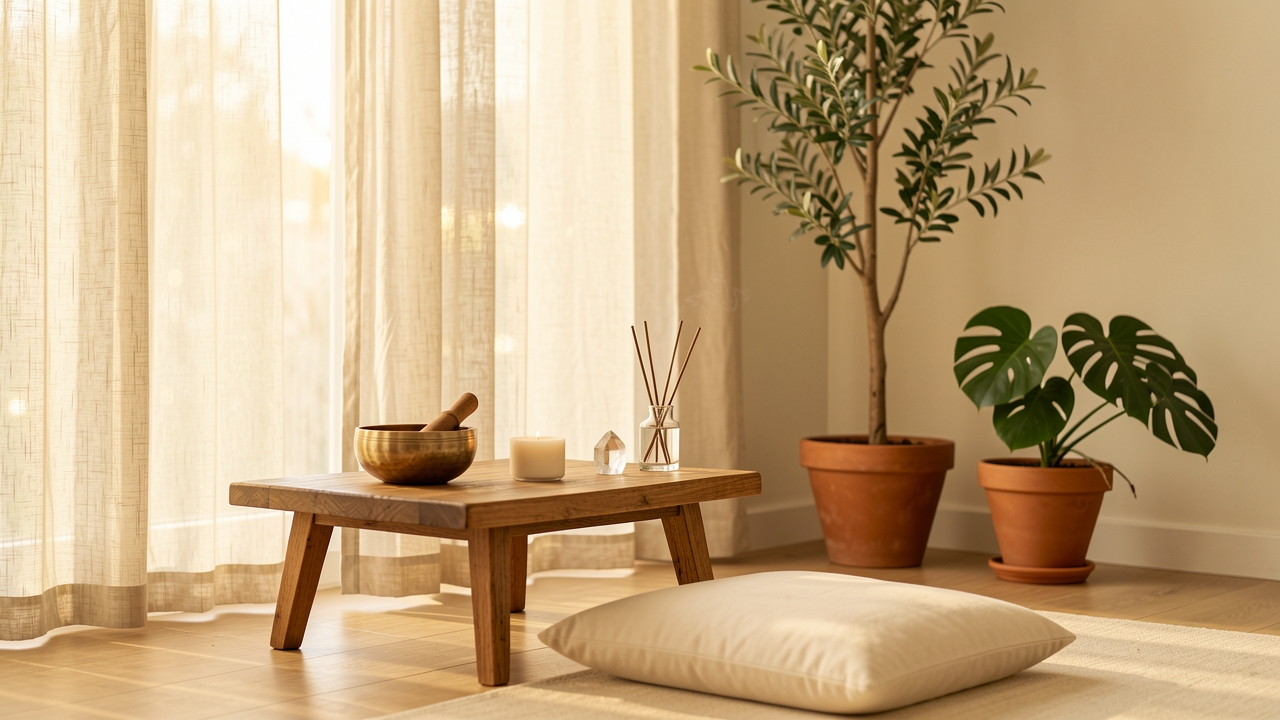
The meditation corner of my Arabian Ranches studio: a candle, a Tibetan singing bowl and living plants — because the 5 bodies are cared for through beautiful, living spaces too.
Why speak of 5 bodies and not just one?
Modern Western medicine works mainly on a single body: the physical one. And it does so with extraordinary results in many areas — surgery, infections, trauma. But a moment comes, especially with chronic stress, sustained emotional processes or diffuse discomfort, when the physical body alone isn’t enough. Something in the organism is asking for another layer of understanding.
Eastern traditions — yoga, Ayurveda, traditional Chinese and Tibetan medicines — have described the human being as a multidimensional structure for thousands of years. They call it koshas in Sanskrit, shen in Chinese, five layers in many modern Western schools. The nomenclature varies, the essence is the same: we are more than flesh and bones.
In holistic therapy practice, working with the 5 bodies means looking at the whole person: not only what hurts, but also what they feel, what they think, what disconnects them and what reconnects them. And from that view, the session stops being a massage or a Reiki and becomes work of integration.
1. Physical body: matter
The physical body is the most obvious: flesh, bones, organs, blood. It’s the body conventional medicine examines, measures, operates on, medicates. It’s real, it’s important, and it’s the foundation of everything: when the physical body isn’t cared for, the other bodies cannot flourish.
When the physical body asks for attention
- Chronic pain
- Physical tiredness
- Digestive issues
- Muscle tension
- Lack of mobility
- Recurrent illnesses
- Poorly accompanied hormonal changes
How to care for the physical body
- Daily movement: walking, yoga, swimming — whatever, but every day
- Sufficient sleep: 7-8 hours, regular hours — this is non-negotiable
- Conscious nutrition: real food, hydration, cycle-based adjustments (especially for women)
- Manual therapies: holistic massage, manual lymphatic drainage, physiotherapy
- Regular medical care: tests, check-ups, not waiting for severe pain
The physical body is the anchor. Without it in good shape, no sustained energetic work is possible.
2. Etheric body: vital energy
The etheric body — also called vital body or pranamaya kosha in yoga — is the layer closest to the physical body. It is the vital energy that animates the organism: the Japanese “ki”, the Sanskrit “prana”, the Chinese “qi”. It isn’t metaphysical — it is the energy Reiki works with, the one that moves through the meridians of Chinese medicine, the one that concentrates in the chakras.
The etheric body is the transition zone between the physical and the subtle. That’s why it’s so important: when it falls out of balance, the effects show in both the physical and the emotional body. And when it’s restored, both feel it.
When the etheric body asks for attention
- Tiredness that rest doesn’t solve
- Sensation of “low energy” without a clear physical cause
- Slow recovery after effort
- Low immune system
- Sensation of “being absent”
- Cold hands and feet without circulatory cause
- Waking up tired even after sleeping
How to care for the etheric body
- Regular Reiki: the most direct tool
- Conscious breathing: 5-10 minutes a day, especially deep diaphragmatic breathing
- Time in nature: walking barefoot, sitting near trees, sea, flowing water
- Specific clinical aromatherapy for vitality: ginger, rosemary, peppermint, lemon
- Gentle conscious movement: yoga, qigong, tai chi
- Chakra work
3. Emotional body: feelings
The emotional body is the layer where emotions live: joy, sadness, fear, anger, love, grief, guilt. When an emotion is felt and processed, the emotional body flows and releases. When it is repressed for a long time, it densifies, becomes loaded and ends up affecting the physical body.
In my Dubai consultation, this is the body I see most out of balance — more than the physical, more than the mental. We live in a culture that rewards the automatic “I’m fine” and penalises emotional expression. The result: women with years of accumulated emotions, without ever having space to feel them.
When the emotional body asks for attention
- Tears that appear without a clear cause
- Constant irritability over small things
- Emotional anaesthesia: “I feel nothing”
- High reactivity to specific topics (grief, relationships, childhood)
- Physical symptoms in emotion-associated areas (closed chest, knot in stomach, clenched jaw)
- Mind obsessively returning to the same theme
- Insomnia with emotional component
How to care for the emotional body
- Space to feel: 10 minutes a day without screens, in silence, letting what arises arise
- Writing: a journal or unsent letters — one of the most effective methods
- Psychological therapy when there are old or intense processes
- Specific Bach Flower remedies: Star of Bethlehem (grief), Willow (resentment), Pine (guilt), Aspen (causeless anxiety)
- Holistic massage: the body stores emotions; working it physically releases the emotional plane
- Aura cleansing: especially useful when other people’s emotions have been absorbed

The daily practice I most recommend in consultation: 10 minutes in the morning of free writing + infusion + candle. For the emotional body, this small ritual changes a great deal.
4. Mental body: thoughts
The mental body is the layer of thoughts, beliefs and cognitive patterns. It’s where the thinking “I” lives: the one that plans, judges, remembers, anticipates. In contemporary society, this is the body that is constantly saturated: 24/7 processing information, decisions, stimuli, social media, conversations, noise.
A healthy mental body isn’t an “empty” one — it is a flexible one: capable of concentrating when needed, of letting go when needed, of truly resting. An unbalanced mental body is the opposite: either constantly saturated, or scattered, or trapped in thought loops.
When the mental body asks for attention
- Obsessive thinking, looping mind
- Difficulty concentrating on a single thing
- Sensation of “too much in my head”
- Insomnia from active nighttime thinking
- Decisions that feel huge even when small
- Deteriorating short-term memory (forgetting why you walked into a room)
- Screen addiction
How to care for the mental body
- Regular meditation: even 10 minutes a day
- Silence: stretches without stimuli — the brain needs them more than information
- Specific aromatherapy for mental clarity: rosemary, peppermint, lemon, eucalyptus
- Reduce screens, especially the first hour of the day and the last before bed
- One thing at a time: multitasking degrades the mental body
- Walking without podcast or music: let thought flow
- Third-eye chakra work and Tibetan singing bowl — both very directly calm mental activity
5. Spiritual body: connection
The spiritual body is the most subtle layer and the hardest to describe. It isn’t necessarily about religion — it’s about meaning: the sense of belonging to something larger, the sense of purpose, the sense that your life matters in a dimension beyond the everyday.
When this body is well, there is a background sense of “being in the right place” even when life is complicated. When it is disconnected, what we call existential crisis appears: emptiness, “what’s all this effort for”.
In Dubai, a city of great pace and ambition, this is a body I see very neglected in consultation. Not for lack of success — on the contrary, it’s often after success when the question arrives: “and now what?”
When the spiritual body asks for attention
- A sense of emptiness that external things don’t fill
- Crisis of meaning: “what am I doing all this for”
- Disconnection from your intuition
- Existential loneliness even with a good social life
- Lack of deep inspiration or motivation
- Inner search without knowing what you’re searching for
- Especially common after great successes, great losses or life changes
How to care for the spiritual body
- Contemplation: time simply to be — no purpose, no agenda
- Nature: long walks, watching the sea, looking at the sky
- Personal rituals: a morning candle, a conscious infusion, gratitude before sleep
- Spiritual practices that resonate with you: yoga, meditation, prayer, inspiring reading
- Crown chakra work
- Deep conversations with people who take you beyond small talk
- Service: helping others selflessly deeply nourishes the spiritual body
How are the 5 bodies related to each other?
This is the key part: the 5 bodies aren’t separate. They constantly influence each other, in both directions:
- A repressed emotion (emotional body) ends up creating muscle tension (physical body) and obsessive thinking (mental body)
- Chronic physical tiredness (physical body) drains vital energy (etheric body) and lowers spiritual connection (spiritual body)
- A difficult spiritual process (spiritual body) can express itself as anxiety (emotional body) and exhaustion (etheric body)
- A meditative practice (mental body) reduces inflammation (physical body) and opens the spiritual plane (spiritual body)
That’s why in holistic work we never address one body in isolation: always, when working one, you are affecting the others. And that’s why a well-done session — even if it starts with physical massage, or even if it’s energetic Reiki — ends up touching all five.
How I work with the 5 bodies in my studio
In my Arabian Ranches consultation, every session is designed to touch several bodies at once. Not always all five — it depends on what the client brings that day — but always more than one.
- Holistic massage: physical, emotional, energetic bodies — all at once
- Reiki: etheric, emotional, spiritual bodies
- Lymphatic drainage: physical, etheric bodies
- Bach Flower remedies: emotional, mental bodies
- Clinical aromatherapy: emotional, mental, etheric bodies
- Tibetan singing bowl: etheric, mental, spiritual bodies
- Aura cleansing: etheric, emotional, spiritual bodies
- Chakra work: all five bodies, each chakra resonating with several
In the initial conversation of each session I listen to which body is asking for primary attention — and from there I design the combination of tools for that session.
Book your first session here — new clients receive 10% off.
Frequently asked questions about the 5 energy bodies
How do I know which body is most out of balance in me?
A simple way: read the symptoms. Pain or unexplained physical problems? Physical body. Tiredness that sleep doesn’t solve? Etheric body. Emotions on the surface or emotional numbness? Emotional body. Mind that won’t stop? Mental body. Sense of emptiness of meaning? Spiritual body. If you identify with several, that’s usually a good sign — it means you’re listening to what you need.
Do I need to work all five bodies at once?
Not at first. The most efficient is to start with the one that’s asking most — and by working one, the others benefit. For example, if you arrive with anxiety-driven insomnia, we can start with the etheric and emotional bodies through Reiki sessions, and that lowers mental activity and helps the physical body naturally.
Is this science or spiritual tradition?
A mix. The physical and etheric bodies have recognised scientific basis (anatomy, neurophysiology, autonomic nervous system). The emotional and mental bodies are understood by modern psychology. The spiritual body is worked with by contemplative traditions across cultures. The way to integrate them comes from ancient holistic traditions and from new integrative medicine — an increasingly studied field.
Can I care for the 5 bodies on my own without sessions?
Yes, partially. Much of the work is daily personal practice: sleep, nutrition, meditation, nature, writing, rituals. Holistic therapy sessions bring something different: an external reading of your bodies’ state, professional tools for deep processes, and acceleration of changes that alone would take much longer.
How often should I have an integrative session?
For maintenance: one session every 3-4 weeks is the frequency I most recommend. For active processes (chronic stress, life transition, recovery): a cycle of 5 sessions spaced 7-10 days apart, then monthly maintenance.
← Back to blog · Book a session · What is Reiki? · The 7 chakras · Clinical aromatherapy · Bach Flower remedies · Aura cleansing